The World Meteorological Organization (WMO) has confirmed that June 2026 was the second-warmest June on record globally, as the planet continues to accumulate heat at an alarming rate.
According to the latest monthly bulletin from the Copernicus Climate Change Service (C3S), the global average surface air temperature in June 2026 reached 16.54°C.
C3S said this was 0.56°C above the 1991–2020 average for June, placing it just behind the record set in June 2024. The agency added that global temperatures for the month were 1.39°C above pre-industrial levels (1850–1900), bringing the world dangerously close to the critical 1.5°C threshold.
DRIVERS OF EXTREME HEAT
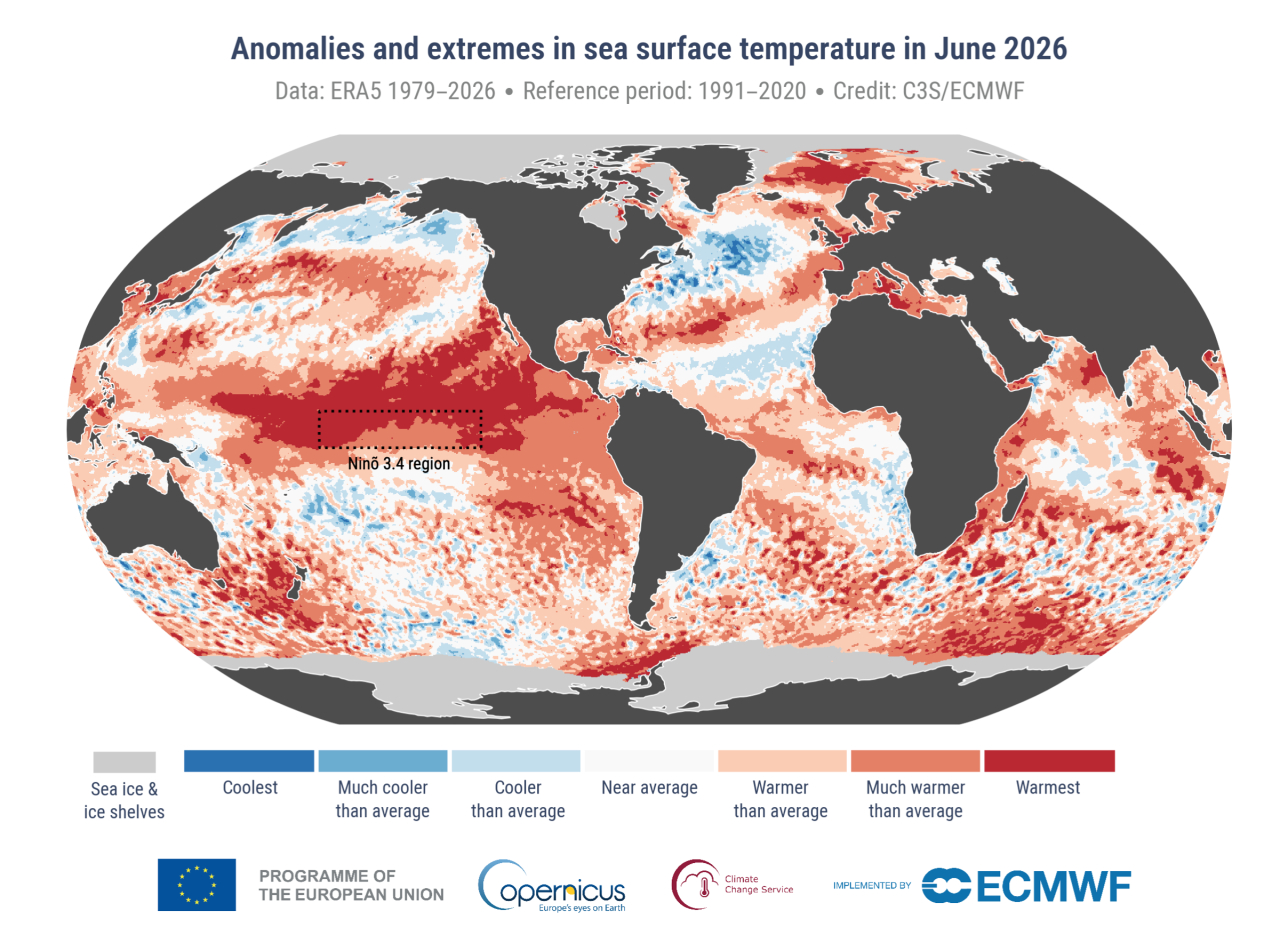
C3S said the near-record global heat was primarily driven by unusually warm oceans.
“Globally, the monthly average SST (sea surface temperature) for the extra-polar ocean (60°S–60°N) was the highest for June, exceeding the previous record set in June 2024 by just 0.01ºC, partly reflecting the development of strong El Niño conditions in the equatorial Pacific,” it said.
At 20.86°C, global ocean temperatures slightly surpassed the previous June record by 0.01°C.
Scientists have linked this “oceanic fever” partly to the emergence of a strong El Niño in the equatorial Pacific, which could intensify in the coming months.
Samantha Burgess, Strategic Lead for Climate at the European Centre for Medium-Range Weather Forecasts, warned:
“June 2026 underscored how profoundly the climate is changing. Western Europe recorded its warmest June on record, and continued record warmth in the global ocean. Together, these records reflect a climate system continuing to accumulate heat. The result is increasingly intense heatwaves, a persistently warm ocean, and growing risks for people, ecosystems and infrastructure across Europe and beyond.”
EUROPE RECORDS HOTTEST JUNE
Zooming in on Europe, C3S reported that Western Europe experienced its hottest June on record, driven by prolonged heatwaves across the western Mediterranean and Atlantic coasts.
“The heatwave that hit much of Europe during the second half of June came only a few weeks after a particularly intense heatwave in May, with another heatwave emerging in early July,” it said.
“The June heatwave broke monthly and all-time temperature records across several European countries and contributed to severe health impacts, including heat-related deaths.”
Regional data showed Western Europe’s average temperature reached 20.74°C—about 3.06°C above the 1991–2020 average—surpassing the previous record set in June 2025.
Among the countries hardest hit, Germany, France, and the United Kingdom recorded extreme temperatures.
In Germany, the WMO said temperatures peaked at 41.7°C in Coschen, with 252 weather stations breaking records.
France recorded a high of 43.8°C in Pulluau, marking its hottest average national day at 30.0°C.
In the United Kingdom, temperatures reached 37.3°C in southern England, prompting authorities to issue a three-day Red Warning for extreme heat.
WHAT DOES THIS MEAN FOR THE WORLD?
The WMO warned that extreme heat remains a “silent killer” and is often underreported globally.
Heat stress occurs when the body absorbs more heat than it can release, and prolonged exposure can be dangerous.
“Prolonged exposure over several days, particularly when temperatures remain high at night, means the body enters each new day already stressed. Older adults, young children, pregnant women, outdoor workers and people unhoused or living with chronic illness are among those most at risk, but heat stress can affect anyone when temperatures are extreme enough for long enough,” said Lachlan McIver of the WHO-WMO Climate and Health Joint Office.
The WMO also highlighted the rise of “tropical nights,” when temperatures do not fall below 20°C, limiting the body’s ability to recover.
“Night time is when the body is supposed to recover. When we sleep, our core temperature drops, our cardiovascular system rests, and the cumulative stress of a hot day begins to ease. When nights stay warm, that recovery does not happen. The body remains under strain around the clock,” explained Armel Castellan.
The United Nations also issued a stark warning, saying more extreme weather events are expected.
“We have just lived through the eleven hottest years ever recorded. Climate disasters are becoming more frequent, more destructive, and more costly. And the World Meteorological Organization has warned we ain’t seen nothing yet. El Niño is not just knocking on the door. It risks blowing the house down—turning up the heat, disrupting food and water systems, and hitting the vulnerable the hardest,” said Antonio Guterres.