The Philippines may be enduring one of its final oil crises, with an economist arguing that electric vehicles and remote work are dismantling the structural vulnerability that has made every fuel shock a national emergency.
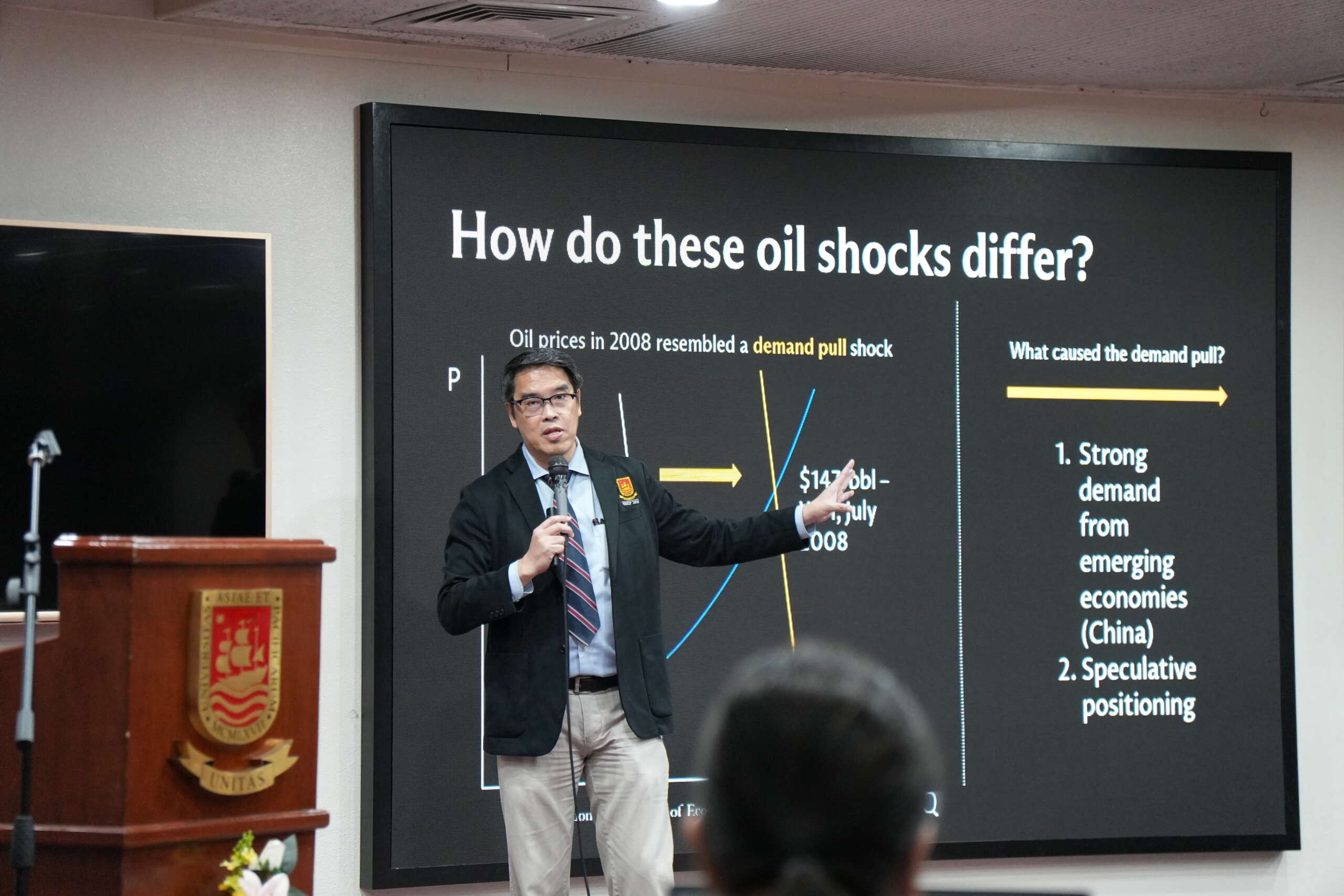
University of Asia and the Pacific (UA&P) School of Economics Dean Dr. Peter Lee U made the assessment during a forum on the energy sector, arguing that two forces now converging — the rapid adoption of electric vehicles and the normalization of remote work — are dismantling the structural conditions that have made every oil price spike a national emergency.
“This is probably the last — or, to be safe, second to the last — oil crisis that we will face,” Dr. Lee U said on Wednesday, April 29. “The last frontier, really, for the Philippines, and actually for the whole world, of being away from oil — within the area of transportation — and now modern technology has brought us to a point where we can actually substitute away from oil.”
The economist anchored his argument on data showing that transportation accounts for roughly 55 percent of the country’s total final oil consumption — approximately 120 out of every 180 units of oil used.
As long as that sector remained tethered to fossil fuels, he said, the Philippines would remain acutely exposed to supply shocks such as the current one triggered by the US-Israeli strikes on Iran and the closure of the Strait of Hormuz.
That vulnerability, Dr. Lee U argued, is now being structurally eroded. He pointed to the surge in electric vehicle sales as a leading indicator, noting that EV adoption had grown by as much as 400 percent following the outbreak of the current conflict — a dramatic acceleration from an already rising pre-war baseline of around 30 percent growth.
“I think all of you saw already — even before the war — the great increase in sales of electric vehicles,” he said.
The shift, he said, is not limited to private cars. Buses and other forms of mass transport are beginning to electrify as well, though he acknowledged the pace would be slower for larger vehicles.
“Even buses — although I think that might take a bit slower, the take-up,” he said. Once land transport — the segment he described as the most feasible to transition away from oil — is substantially electrified, he said the country’s exposure to oil price volatility would shrink to what he called mere “hiccups.”
The second structural shift Dr. Lee U highlighted was remote work, which he credited the COVID-19 pandemic with normalizing as a viable alternative to daily commuting.
“We already were forced to do it, and the dress rehearsal was COVID,” he said. “So now we can bring it back — whoever can work from home without compromising significantly too much the productivity of the entire firm, you can work from home.”
He noted that universities including Ateneo de Manila University and De La Salle University, as well as numerous private firms, have adopted hybrid schedules that keep workers and students off the road on certain days, directly cutting into fuel demand.
Dr. Lee U was careful to note that electric aviation and electric shipping remain far beyond the practical horizon, meaning oil will retain a role in those sectors for the foreseeable future.
“I don’t think yet around the horizon are electric airplanes — electric ports, I’ve heard, I’ve seen and read — but I don’t think you can have an electric VLCC tanker yet,” he said. But with land transport representing the dominant share of the country’s oil consumption, he said the math increasingly favors a future where oil crises, if they come at all, carry a fraction of the economic pain Filipinos have absorbed through every spike from 2008 to today.