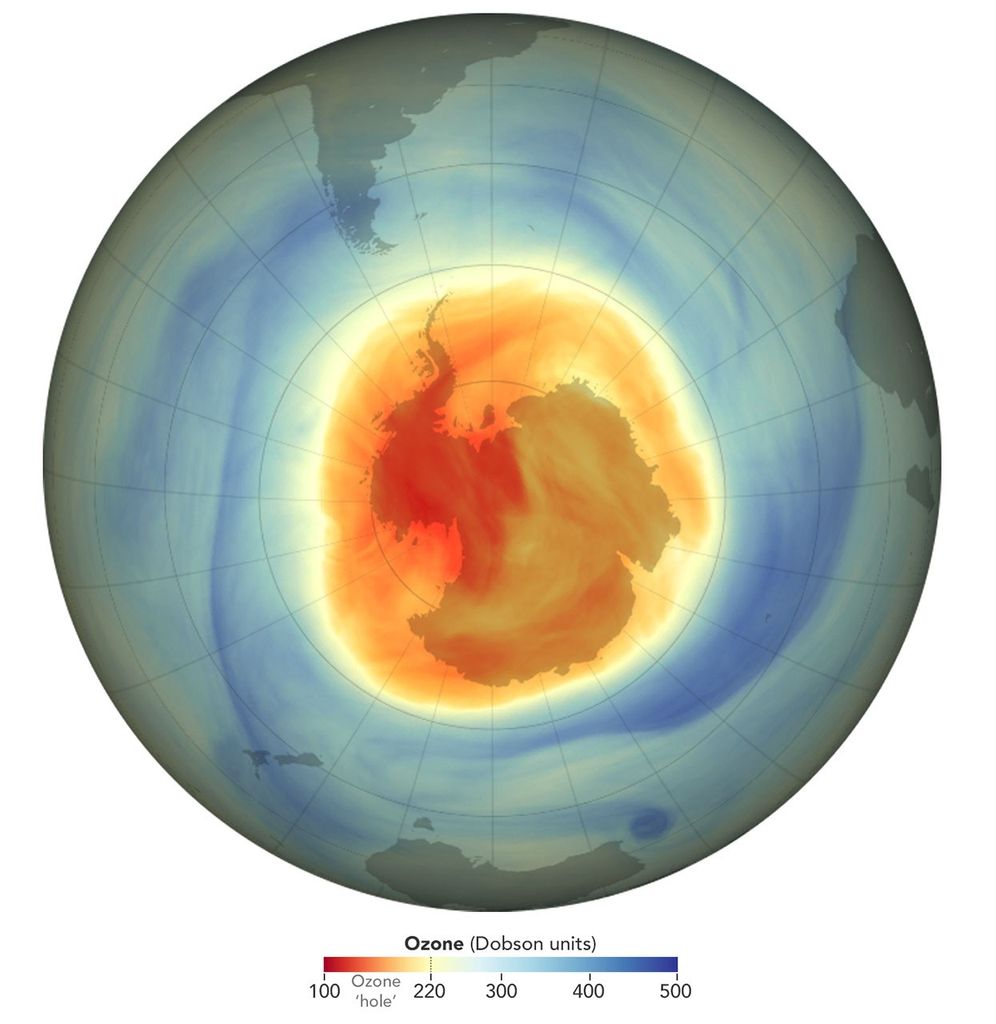
Newly released measurements from the National Aeronautics and Space Administration (NASA) and the National Oceanic and Atmospheric Administration (NOAA) show that the ozone hole reached its seventh-largest size on record, marking its largest extent in a decade.
Scientists continue to monitor the ozone layer, which serves as Earth’s protective shield against the sun’s harmful ultraviolet radiation.
According to satellite data, the ozone hole reached its peak extent for the year on September 18, measuring 10.5 million square miles (27.1 million square kilometers).
Although this is roughly 90% of the record size recorded in September 2000, scientists emphasized that the temporary expansion does not reverse decades of progress in ozone layer recovery.
“The 2026 ozone hole is large but could have been 1 to 2 million square miles (3.5 million square kilometers) larger if ozone-depleting substances were as prevalent in the atmosphere today as they were at their peak in 2000,” said Paul Newman, a senior scientist at the University of Maryland, Baltimore County, and longtime leader of NASA’s ozone research team.
NASA scientists attributed the expansion largely to an unusually strong and stable Antarctic polar vortex, a powerful band of winds that created favorable conditions for ozone depletion over the South Pole.
However, scientists noted that despite covering a vast geographical area, the ozone hole remained relatively shallow compared with historical extremes, indicating widespread thinning rather than severe depletion.
Despite its alarming size, scientists stressed that international environmental policies continue to work as intended.
NASA researchers explained that chlorofluorocarbons (CFCs) and other ozone-depleting substances, once commonly used in refrigerators and aerosol cans, have steadily declined following the implementation of the 1987 Montreal Protocol.
“As part of that agreement, countries committed to replacing ozone-depleting substances with less-harmful alternatives,” NASA said in a news release.
Stephen Montzka, a senior scientist at NOAA’s Global Monitoring Laboratory, also noted that chlorine levels in the Antarctic stratosphere, largely originating from ozone-depleting substances, have declined to about one-third of their 1980 levels since reaching their peak.
However, NASA cautioned that CFCs remain a concern because these chemicals can persist in the atmosphere and in older products and landfills for decades.
“As those legacy compounds break down, scientists estimate that the ozone hole will recover by the 2070s,” NASA said.
© NASA