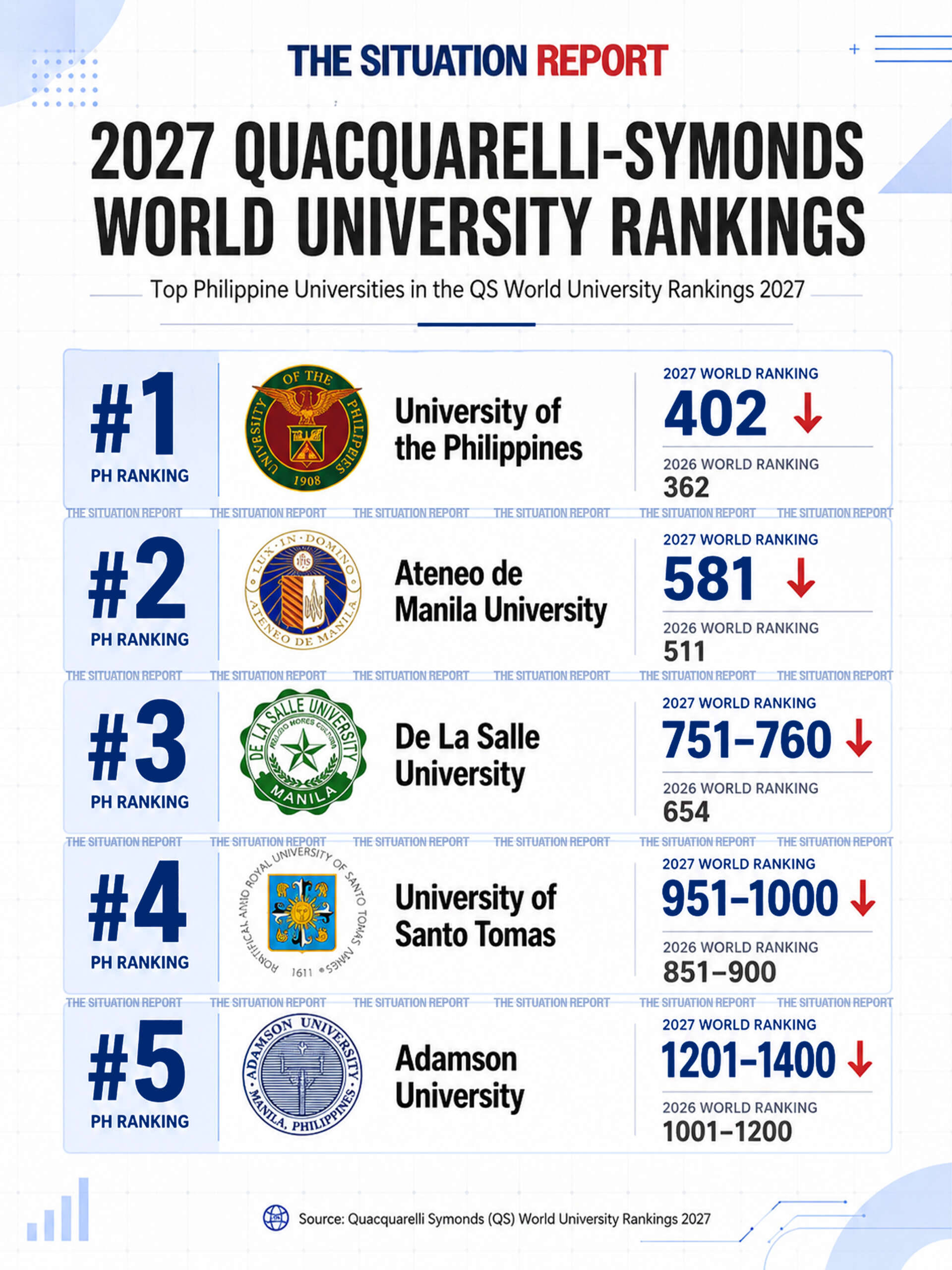
Five Philippine universities made it to the 2027 Quacquarelli Symonds (QS) World University Rankings, but all saw declines from their previous standings.
The University of the Philippines (UP) remained the country’s highest-ranked institution, despite dropping 40 places from 362nd to 402nd.
Ateneo de Manila University ranked second among Philippine schools, falling 70 places from 511th to 581st. De La Salle University also slipped, moving from 654th to the 751–760 bracket.
The University of Santo Tomas ranked fourth, declining from the 851–900 range to the 951–1,000 bracket, while Adamson University placed fifth, dropping from the 1,001–1,200 range to the 1,201–1,400 bracket.
In its report, QS said the downward trend was not unique to the Philippines, noting that more than 660 universities worldwide also fell in the rankings. Over 400 institutions improved, while more than 330 remained stable.
QS said the results indicate that “Filipino institutions are not keeping up with advances seen in other higher education systems” globally.
QS Senior Vice President Ben Sowter said the findings suggest that global peers are progressing at a faster pace in areas such as research output, international partnerships, and graduate employability.
Despite the overall decline, Philippine universities recorded gains in several indicators. Ateneo rose 15 places in Employment Outcomes to 142nd globally and improved in Sustainability. De La Salle also posted gains in Sustainability, while Adamson improved in International Faculty.
QS also noted that the Philippines now has two universities within the world’s top 40%, an improvement from 2017, indicating a gradual expansion of the country’s presence in global higher education.
Globally, the Massachusetts Institute of Technology remained the top-ranked university for the 15th consecutive year.
The National University of Singapore, the only Asian institution in the top 10, ranked 10th, down two places from eighth last year.
The QS World University Rankings 2027 evaluated more than 1,500 universities across 106 countries and territories, based on indicators such as academic reputation, research impact, employability, internationalization, and sustainability.