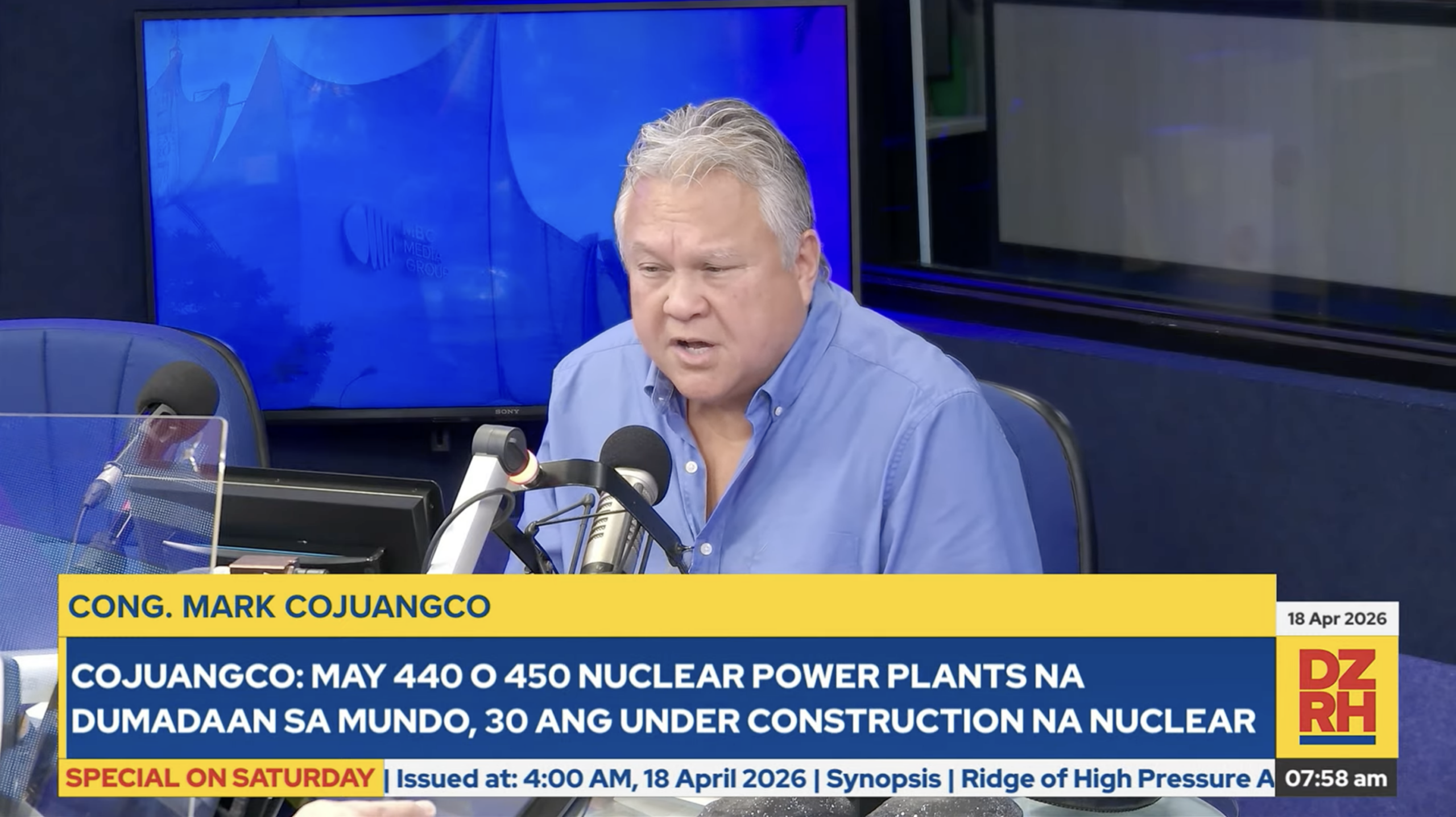
The Philippines could slash its fuel import costs by as much as 20 times by shifting to nuclear power, yet the country continues to source roughly three-quarters of its electricity from coal and natural gas, Pangasinan Rep. Mark Cojuangco said Saturday, April 18.
Cojuangco, chairman of the House Special Committee on Nuclear Energy, said the country’s 22,000-megawatt generating capacity remains heavily dependent on imported fossil fuels.
“65% po niyan ay imported na coal, galing pong Indonesia, at 10% po noon ay galing po sa ating Malampaya. Ang Malampaya po ay mabilis nang nauubos, kaya kung lalaki po ang pangangailangan ng kuryente sa Pilipinas, kung gas ang pinag-uusapan dahil bawal na ang coal, magiging imported na LNG po yan,” he said on DZRH News program “Special on Saturday.”
Wind and solar, often cited as the primary alternatives to fossil fuels, contribute only about one to two percent of the total electricity mix. Hydro and geothermal make up the bulk of the remaining renewable share, but Cojuangco said both are constrained by geography and cannot grow fast enough to meet rising demand.
“Hanggang sa kakayahan ng ating natural resources, posible pong ang hydro at geothermal ay lumaki pa ng konti, pero wala tayong nakikitang in the foreseeable future. Walang kasing-laki ng ating pangangailangan,” he said.
He was equally skeptical of the government’s target of sourcing 50 percent of delivered electricity from wind and solar by 2040.
“Ang solar po, ang capacity factor is 15%. Ibig sabihin, pag sinabi mong 100 megawatts, totoo yun 15% of the time. It’s not 100% all the time, kasi may gabi, di ba? May ulap, di ba? Six months of the year nasa monsoon tayo, maulap. So mahina ang solar. Ang wind naman 40% ang capacity factor. Meaning kung minsan wala talagang wind, as in zero. So walang lalabas diyan,” he said.
Countries that lean heavily on intermittent renewables end up competing for expensive liquefied natural gas imports against wealthier nations with secured long-term supply contracts, he warned.
“Ang China po ay bumili nang 20 years ng buong supply ng Oman or one of those countries sa Middle East. So ang China po ang magiging may guaranteed supply. And I think hindi lang ang China ang may kapabilidad na gumawa niyan. Japan, Korea, kayang gumawa niyan. Tayo hindi,” he said.
Nuclear power, by contrast, offers a stable and dramatically cheaper fuel source.
“Sa bawat 1,000 megawatts, kung fossil fuel po yan, gagastos tayo every year ng around $400 million in importing coal or gas. Pero kung nuclear, $20 million lang. So 20 times cheaper! Ang laki pong pagbabago niyan. Yan ang hindi maintindihan ng tao, yung energy density ng nuclear. Yun po ang malaking diperensya,” he said.
The scale of the need is significant. The Department of Economy, Planning and Development (DEPDEV) projects that Philippine electricity demand will double by 2040 and could triple beyond that. Cojuangco said nuclear does not need to replace existing fossil fuel plants to make a difference; covering only the incremental growth in demand would require between 16,000 and 32,000 megawatts of new nuclear capacity.
“Pwede po tayong magsagawa ng 16,000 to 17,000 megawatts ng nuclear, kasi yan po ang katumbas ng 65% to 75% fossil fuel na hindi natin ginagalaw yung existing fossil fuels. In other words, incremental growth pwede pong maging nuclear,” he said.
The missing piece, Cojuangco said, is legislative clarity. The pending Nuclear Integration Bill would define the country’s nuclear energy targets and establish the market terms needed to attract private investment.
Without a clear mandate, he warned, the country risks being left behind as the rest of the world accelerates its nuclear buildout.
“Subukan niyo na ang nuclear, dahil yan na lang ang teknolohiya na hindi niyo pa nasubukan. At ayon sa ating konteksto sa Pilipinas, mahirap po tayo sa fossil fuels. Hindi katulad ng Vietnam na may sariling coal, kaya triple na ang dami ng kuryente ng Vietnam kumpara sa Pilipinas na dati nangunguna tayo eh. So mga pulitiko, kumilos na kayo, mag-nuclear na tayo,” he said.