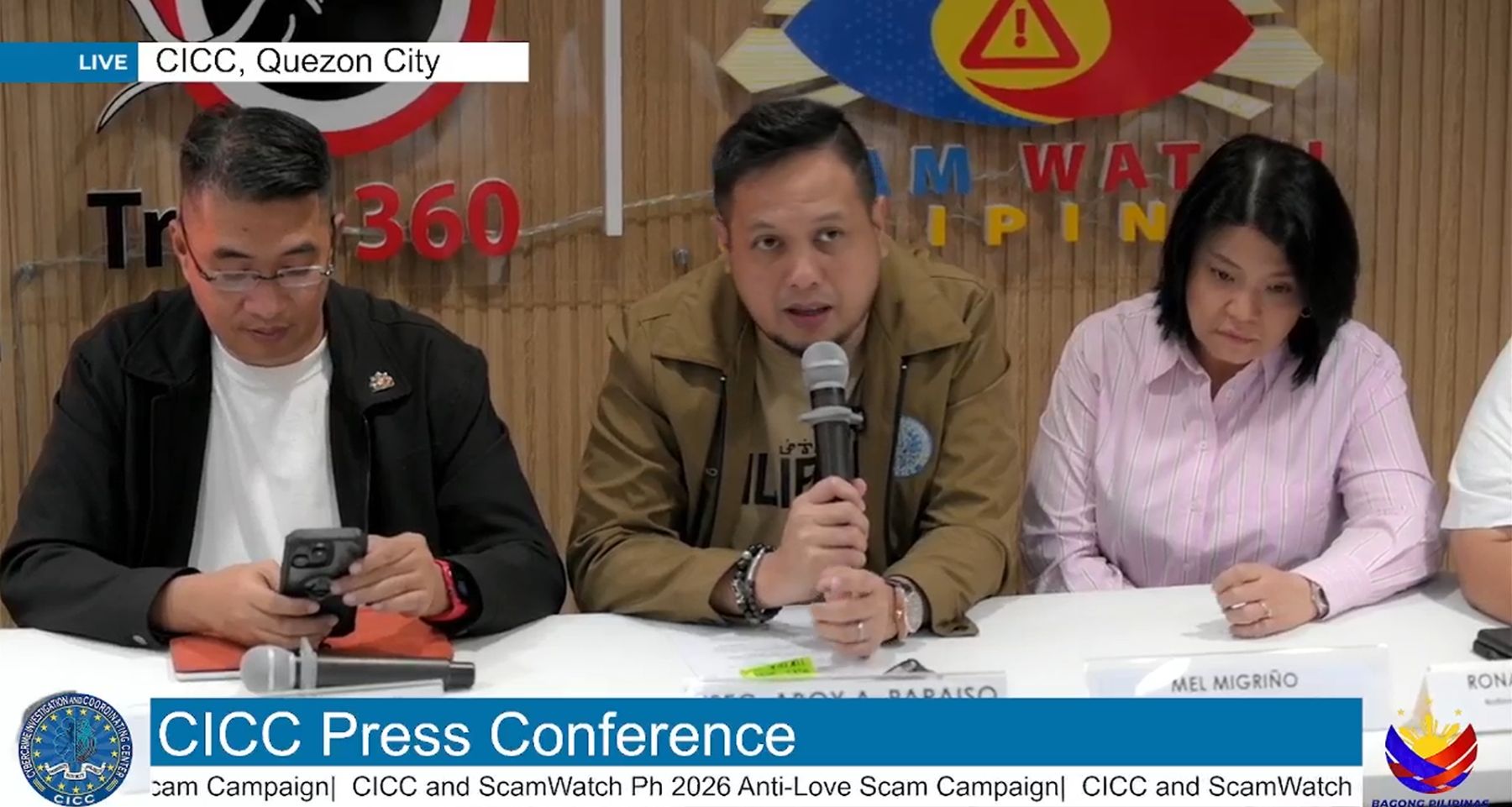
The Cybercrime Investigation and Coordinating Center (CICC) on Monday launched a nationwide public information drive to counter the growing use of artificial intelligence in online romance scams, warning that scammers are now exploiting Filipinos’ emotions with increasingly sophisticated digital tools.
Dubbed “AI-I-I Feb-IBIG,” the campaign brings together government, civil society, and private sector partners to educate the public on how love scams have evolved—from simple fake profiles to AI-generated photos, scripted conversations, and manipulated video calls designed to appear authentic.
“Let this sink in: the connection felt real because AI made it so. You felt feelings. They are real feelings, but they fed your artificial lives,” CICC Acting Executive Director Usec. Aboy Paraiso said during the launch.
Data from the CICC’s Cybercrime Complaint Center show that love scams remain a persistent threat, with 123 formal complaints recorded in 2025 and 15 additional reports already logged in January 2026, despite the year having only recently begun.
Paraiso said the demographic data debunks the notion that only older or isolated individuals fall victim to romance scams, noting that cases are almost evenly split between men and women, with the largest number of victims coming from the 18-to-29 age group.
“This proves that being tech-savvy does not mean that you are scam-proof. Emotions can bypass the firewall of even the smartest digital native,” Paraiso said.
Scam Watch Pilipinas co-founder Jocel De Guzman said love scams are increasingly used as an entry point for larger financial crimes, including cryptocurrency, foreign exchange, and gold investment fraud, which often unfold over long periods and involve repeated transfers rather than one-time transactions.
“So yung pinaka-red flag sa lahat ng scamming: hihingi na ng pera nang hindi pa kayo nagme-meet,” De Guzman said.
As part of the campaign, the CICC said it will roll out educational materials across social media platforms, highlight common scammer and victim profiles, and promote early reporting through Hotline 1326, which authorities say is critical to blocking numbers, websites, and accounts before more victims are targeted.
“If you are a victim, do not let shame keep you silent. Silence is the scammer’s best friend,” Paraiso said.