Vietnam is in the grip of a construction frenzy unlike anything Southeast Asia has seen in a generation—and while Hanoi breaks ground on bullet trains, nuclear plants, and the world’s largest stadium, the Philippines is fighting a different kind of battle: keeping fuel affordable for ordinary Filipinos while its own infrastructure ambitions inch forward under the long shadow of corruption.
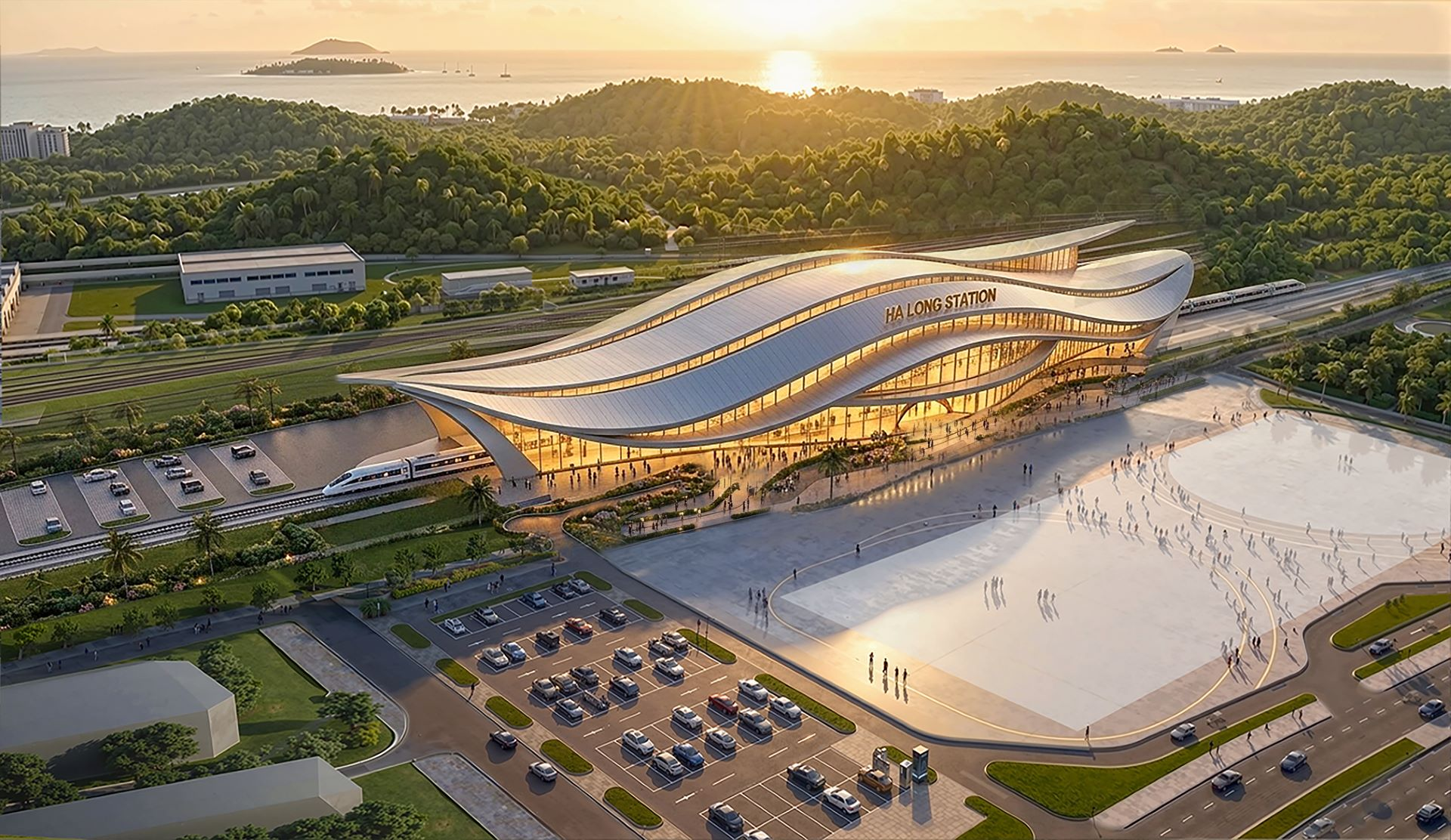
The groundbreaking of the Hanoi-Quang Ninh high-speed railway on April 12—a $5.6 billion project—sent a clear signal that Vietnam’s 2026–2030 term is opening with large-scale construction sites aimed at achieving double-digit growth. And that railway is only the opening move.
Over the next five years, Vietnam aims to mobilize total social investment of $1.54 trillion, equivalent to 40 percent of GDP, significantly higher than the roughly 33 percent seen in the 2020–2025 period. According to VietnamNet, public investment alone for the period is projected at $329 billion — nearly three times the $115 billion committed in the previous term.
The project list staggers the imagination. Among the mega-projects lined up: $68 billion for the North-South high-speed railway, $136 billion for power generation and transmission, $123 billion for metro systems in Hanoi and Ho Chi Minh City, $16 billion for Long Thanh International Airport, and $11 billion for the Ninh Thuan nuclear power plant.
According to Vietnam’s Ministry of Construction, the country also aims to nearly double its expressway network to 6,539 kilometers by 2030, adding 1,721 kilometers between 2026 and 2030 alone at an estimated cost of $30.5 billion. What was once Vietnam’s peak annual investment level is, by Hanoi’s own projections, now the new floor for every year of the decade.
Then there is the stadium. The Trong Dong Stadium, under construction in Hanoi since December 2025, is designed to hold 135,000 spectators—a capacity that would make it the largest football venue on earth, surpassing North Korea’s Rungrado May Day Stadium, India’s Narendra Modi Stadium, and England’s Wembley.
Its architecture draws from the Dong Son bronze drum, a sacred artifact of ancient Vietnamese civilization, and sits inside a 9,000-hectare Hanoi Olympic Sports City projected to cost $38 billion. To appreciate the scale of the ambition: Vietnam’s largest existing stadium holds just 40,000 seats.
Vietnam’s push is also tied directly to the global energy disruption that is hammering its neighbors. According to the international law firm Freshfields, ongoing conflict and instability across the Middle East have made Vietnam more determined to reduce its dependence on imported fossil fuels and accelerate renewable energy development, adding urgency to offshore wind and other clean energy projects.
Disruptions to Red Sea shipping have also redirected maritime traffic through alternative Asian routes, strengthening the commercial case for Vietnamese port infrastructure. The same crisis that is draining Philippine fiscal reserves is, paradoxically, accelerating Vietnam’s infrastructure rationale.
The Philippines, by contrast, has been knocked sideways by that same oil shock. On March 24, 2026, President Ferdinand Marcos Jr. issued an executive order declaring a national energy emergency, citing serious risks to the country’s energy security as traffic through the Strait of Hormuz was disrupted by the escalating conflict in the Middle East.
Energy Secretary Sharon Garin warned that diesel supplies could only last 45 days, and liquefied petroleum gas may run out in just 25 days. The government’s primary response has been subsidies: on April 13, President Marcos announced the removal of excise taxes on LPG and kerosene, expected to reduce prices by about ₱3.36 per liter for LPG and ₱5.6 per liter for kerosene.
But according to ING Think, while the government has some room to extend fuel subsidies, fiscal space is limited, and any additional support would risk further delaying capital expenditure spending, which would in turn slow the broader growth recovery.
The Philippine Institute for Development Studies (PIDS) has put a human face on the damage. Under a high oil price scenario, national poverty is projected to rise from 13.2 percent in 2025 to 14.4 percent, pushing an additional 1.34 million Filipinos—mostly near-poor households—into poverty. The oil price shock is described as highly regressive, with poor households losing 16.2 percent of their real purchasing power compared to just 3.4 percent among the wealthiest.
The Asian Development Bank, in its April 2026 outlook, cut its Philippine GDP growth forecast to 4.4 percent for 2026—a far cry from Vietnam’s double-digit target, and a number that reflects an economy absorbing external shocks from a position of existing vulnerability.
Compounding the oil crisis is an infrastructure corruption problem the Philippines has wrestled with for years. The Commission on Audit and the government’s own Independent Commission for Infrastructure have uncovered the scale of what went wrong. According to the Philippine Daily Inquirer, COA flagged the DPWH for failing to impose liquidated damages on contractors and suppliers who had delays ranging from one to 1,075 days in completing projects and delivery of goods amounting to more than ₱5 billion.
The rot runs deeper. According to the East Asia Forum, the Philippines has lost an estimated ₱42.3 to ₱118.5 billion a year from flood control corruption since 2023, with billions of pesos stolen by individuals in both the private and public sectors—including those tasked with oversight. By October 2025, government inspectors had found 421 ghost projects among approximately 8,000 reviewed, with authorities freezing around ₱180 billion linked to hundreds of bank accounts tied to contractor firms.
The Inquirer reported that the ADB had already trimmed its Philippine growth forecast specifically because prolonged investigations into publicly funded infrastructure projects, combined with potential weather-related disruptions, could further temper the growth outlook.
Back in Vietnam, analysts watching the build-out are raising their own caution flags. Nguyen Khac Giang of the Yusof Ishak Institute, speaking to ABC News Australia, acknowledged Vietnam is entering “a new era, a fever of infrastructure moving” driven by genuine population growth and demand—but pointed to China as a cautionary reference. A country that ran a comparable infrastructure boom a decade or two ago is now dealing with a significantly slowing economy as a partial consequence. “Things can happen similarly for Vietnam,” he said, “if they don’t calculate the efficiency of all of those infrastructure and prioritize what is actually needed most.” Freshfields notes that Vietnam faces a large funding gap, estimated at $150 to $200 billion through 2030, which the government budget, foreign aid, and domestic savings cannot cover on their own.
Vietnam is using a global oil crisis as a reason to build faster. The Philippines is using it as a reason to hand out subsidies. The difference between those two instincts may define where each country stands a decade from now.