Forty years after EDSA, the Philippines finds itself in the middle of another political crisis—a Senate shooting, an ICC arrest warrant, a leadership shakeup, and an impeachment trial all converging in a single week—and former Senator Gregorio “Gringo” Honasan, who has lived through more of these crises than most, has a simple and sobering explanation for why it keeps happening.
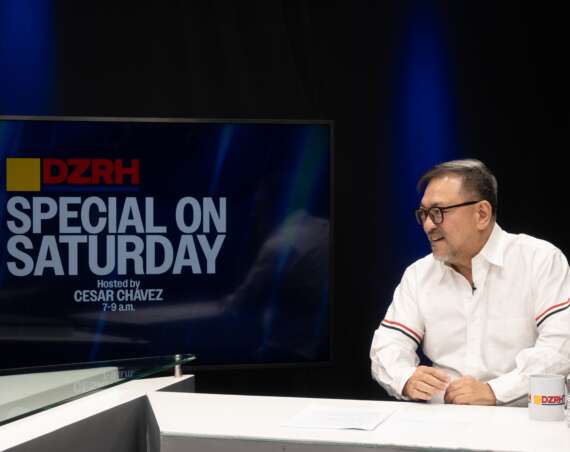
“The more things change, the more they remain the same,” Honasan said in an interview on DZRH News program Special on Saturday, echoing a truth that has haunted Philippine political life for generations.
Honasan traced the roots of the country’s recurring political dysfunction to a pattern that began in 1986—when the opportunity presented by EDSA People Power and the revolutionary government was squandered by a rush to elections rather than a deliberate effort to fix the system.
“Imbis na ayusin muna ‘yung sistema, ‘yung COMELEC. Ayusin ‘yung sistema. Kumbaga, nagpalit lang ng damit,” he said, arguing that the country changed its leaders without changing the structures that enable the same abuses to recur.
The former senator invoked American journalist James Fallows’ controversial 1987 essay “The Damaged Culture”—which argued that the Philippines’ problems stem not from a lack of talent or resources but from a cultural failure to build lasting institutions and transcend narrow loyalties—as a framework that remains relevant nearly four decades later.
“Nag-react tayo lahat doon,” Honasan said of the Filipino reaction to Fallows’ essay, implying that the defensiveness itself was part of the problem—a refusal to confront uncomfortable truths about political culture.
Honasan argued that the Philippines’ geography is not merely a physical fact but a political and cultural one—that being an archipelago of over 7,100 islands has made national unity structurally difficult, and that colonial powers deliberately exploited this by centralizing political and economic power in Imperial Manila.
“Ang pag-iisip pa rin natin ay Ilocano, Bicolano, Bisaya, Muslim. Ngayon i-push mo ‘yung envelope: pro-BBM, anti-BBM; pro-Duterte, anti-Duterte; pro-China, anti-China; pro-US, anti-US. Narinig mo ba ‘yung pro-Pilipino?” he said, pointing to the absence of a unifying national identity as the deepest wound in Philippine political culture.
He described the country’s recurring political cycle as a failure of institutional continuity—where every change of administration brings not just new leaders but an entirely new set of priorities, dismantling what came before regardless of merit.
“Bagong Presidente, bagong Mayor, bagong Senado. Isa sa ugat ng instability natin: bagong administrasyon, walang continuity. Basta identified sa previous, lalo na kung kalaban sa pulitika, may epekto ‘yan doon sa current issue,” Honasan said, calling it one of the deepest roots of the country’s instability.
Honasan said the pattern extends beyond politics into the national psyche—that Filipinos are collectively brilliant and world-class in individual talent, but have consistently failed to translate that talent into lasting national progress because of structural and cultural barriers that no single leader or generation has been willing to dismantle.
“Ganun tayo katinding mga Pilipino sa dunong. World-class tayo. Pero sa dulo, hindi tayo natututo. Paulit-ulit na nangyayari ito,” he said, his words carrying the weight of someone who has watched the cycle play out from both sides of the barricade.
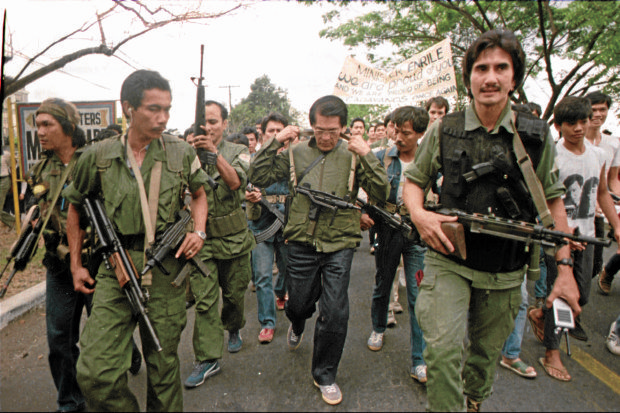
The former senator drew a direct line between the Senate shooting of May 13 and the coup attempts of 1987 and 1989—not in terms of scale or intent, but in terms of the underlying pattern: political crisis, armed confrontation, institutional disruption, and a national conversation hijacked from the real problems of ordinary Filipinos.
“We have been doing the same thing over and over again and expecting a different result,” he said, adding that the country has paid a steep price in lost time and lost focus every time this cycle repeats.
Honasan said the pillars of national security—political unity, social cohesion, and economic prosperity—have been consistently undermined by the inability of the country’s highest leaders to model the kind of dialogue and reconciliation that they ask of ordinary citizens.
“Nanonood tayong lahat, buong mundo, kung ‘yung Presidente at Vice Presidente natin hindi magkasundo, pa’no mo pagkakasunduin ‘yung sambayanang Pilipino sa barangay?” he said, pointing to the Marcos-Duterte rift as the most visible manifestation of a failure of political leadership that cascades downward through every level of society.
Despite the weight of his historical analysis, Honasan stopped short of despair—arguing instead that the very fact that young Filipinos are now speaking out openly, using technology to amplify their voices and hold power accountable, is a welcome and genuinely new development in the country’s long political story.
“Mas gusto ba natin na patago na nag-iingay itong mga bata, nagco-conspire? Mas mabuti itong lantaran,” he said, expressing hope that the next generation—armed with better tools, a steeper learning curve, and less to lose—might finally break the cycle that his generation could not.
Honasan closed with the phrase that has defined his political life and that he says belongs not to any one generation but to the Filipino people as a whole—a refusal, in the face of everything, to give up. “Hindi tayo authorized na mawalan ng pag-asa. We cannot lose this country by default. Too much is at stake,” he said.