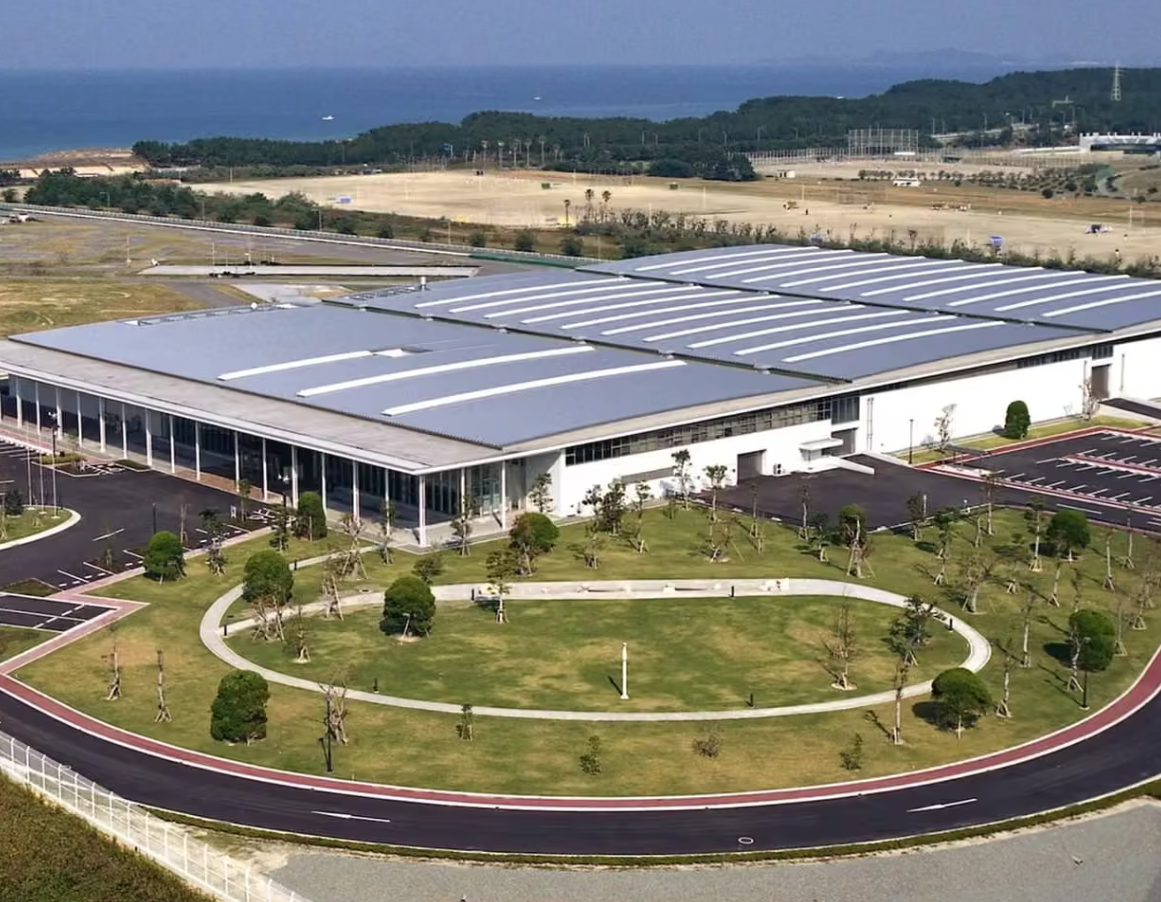
FUKUOKA — A Japanese water plant is harnessing the power of osmosis to generate renewable energy that engineers believe could one day become a common power source.
The osmotic plant in Fukuoka, which opened in August 2025, is only the second of its type in the world — the first was built in 2023 in Mariager, Denmark by venture company SaltPower, according to University of Melbourne Prof. Sandra Kentish.
The facility is expected to generate up to 880,000 kilowatt hours of electricity each year, enough to help power the desalination plant that supplies fresh water to the city and its surrounding region. Dr. Ali Altaee from the University of Technology Sydney, who specializes in the development of alternative water sources, said this is equivalent to powering about 220 Japanese households.
How does osmosis work?
Osmosis is the natural process where water molecules move across a semipermeable membrane from a less concentrated solution to a more concentrated one — similar to how a cucumber releases water when sprinkled with salt. At scale, that movement can be significant enough to spin a turbine and generate electricity.
The $4.4 million (700 million yen) facility draws in highly saline wastewater from a desalination plant and treated sewage from a nearby facility. Freshwater and seawater are placed on either side of a special membrane, with the seawater slightly pressurized. As water flows toward the saltier side, it increases the volume of the pressurized solution, which is then used to produce energy.
In the Fukuoka facility, treated wastewater and seawater are placed on either side of a membrane. As the seawater side increases in pressure and decreases in salinity, water is channeled through a turbine connected to a generator, producing power.
Why Fukuoka?
Fukuoka is well-positioned to benefit from osmotic technology due to its readily available supply of extremely salty water. With no major rivers to sufficiently source its water, the city of 2.6 million has relied on a major desalination plant for drinking water since 2005 — leaving it with large quantities of concentrated saline waste to manage.
Where else is osmotic technology being used?
Pilot-scale demonstrations have taken place in countries including Norway and South Korea. Altaee said the Japanese plant is larger than the one in Denmark, though both have almost the same operating capacity. Altaee also noted that UTS has its own prototype in Sydney, though the program lost traction during the COVID-19 pandemic. He has also helped build prototypes in Spain and Qatar.
The challenges
While the concept is simple, scaling it up remains difficult.
“While energy is released when salt water is mixed with fresh water, a lot of energy is lost in pumping the two streams into the power plant and from the frictional loss across the membranes. This means that the net energy that can be gained is small,” Kentish said.
However, she noted that advances in membrane and pump technology are steadily reducing these problems. Engineers also acknowledged that the system currently costs “a lot more” than fossil fuels or other renewable energy sources, partly because it required building a one-of-a-kind facility.
The future of osmotic plants
Both Kentish and Altaee agree that the Fukuoka plant is proof that osmotic technology can be used for large-scale energy production. The newly opened plant will undergo a five-year test to monitor its performance, including costs and maintenance, particularly for parts exposed to salt.
Unlike solar and wind energy, osmotic power is not dependent on weather or light — giving it a steady, round-the-clock advantage.
Tetsuro Ueyama, research and development manager at Nagasaki-based engineering firm Kyowakiden Industry, said the technology could also benefit countries with large desalination facilities, such as Saudi Arabia and other Middle Eastern nations. The company aims to build plants five to ten times the current scale.
“If osmotic power generation technology advances to the point where it can be practically used with ordinary seawater, this would represent a major contribution to efforts against global warming,” said Kenji Hirokawa, manager at the Sea Water Desalination Plant.
“First we want to popularize this technology from Fukuoka to the rest of Japan,” Ueyama said. “We don’t think this is a pipe dream.” — Photo from the Fukuoka Area Waterworks Agency