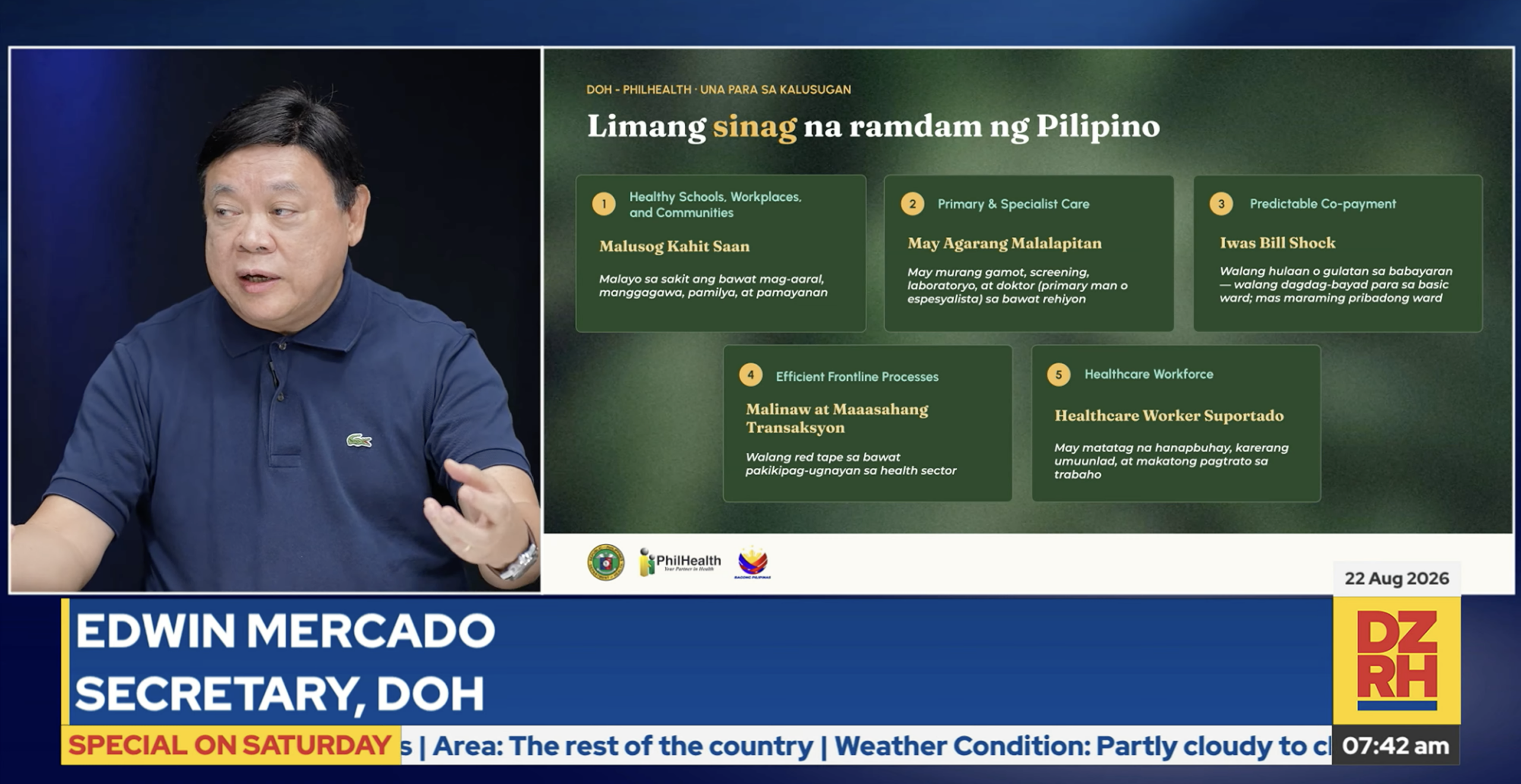
The Department of Health (DOH) will use telemedicine and roving health teams rather than fixed clinics to bring healthcare to geographically isolated and disadvantaged areas, acknowledging that brick-and-mortar health facilities are not always feasible in island communities and remote barangays, newly appointed Health Secretary Edwin Mercado said Saturday.
Mercado made the statement in an interview on DZRH News program Special on Saturday on August 22, as part of the DZRH SONA 2026 Series featuring the DOH.
The newly appointed DOH chief said President Ferdinand Marcos Jr. specifically directed the DOH to reach GIDA areas as a priority, and that the department is studying how to bring last-mile medicine delivery to these communities using private sector partners accredited by PhilHealth.
“Tinitingnan namin, baka pwede yung i-telemed o merong mga talagang roving team na iikot nang mas regular. At meron din tayong mga delivery channel ng last mile nung gamot, kasi hindi naman pwedeng mag-stock up ng marami dun. So ‘yun yung pag-aaralan at sinasangguni nga namin. Kung mako-cover naman ng PhilHealth ‘yun, baka may mga interested na private sector provider na pwedeng mag-deliver nung last mile,” Mercado said.
PhilHealth CEO Beverly Ho said the current Yakap accreditation guidelines assume a permanent physical clinic, which does not fit the reality of many GIDA settings, and that new implementation guidelines are being developed to allow roving clinics and mobile pharmacies to be formally accredited.
She said similar flexibility is being built into the implementation of Yakap in schools, where the current standard varies widely across DepEd regions, and the DOH is working with DepEd and DSWD to set a single standard for health services in public schools covering 25 million school children.
Mercado said the goal is to ensure that no Filipino is left out of the healthcare embrace simply because of where they live, and that the UNA framework’s first pillar—healthy communities, schools, and workplaces—explicitly includes sitios, far-flung barangays, and island communities that have historically been the last to receive government services.