The world’s “most difficult” railway project is taking shape in rugged southwestern China.
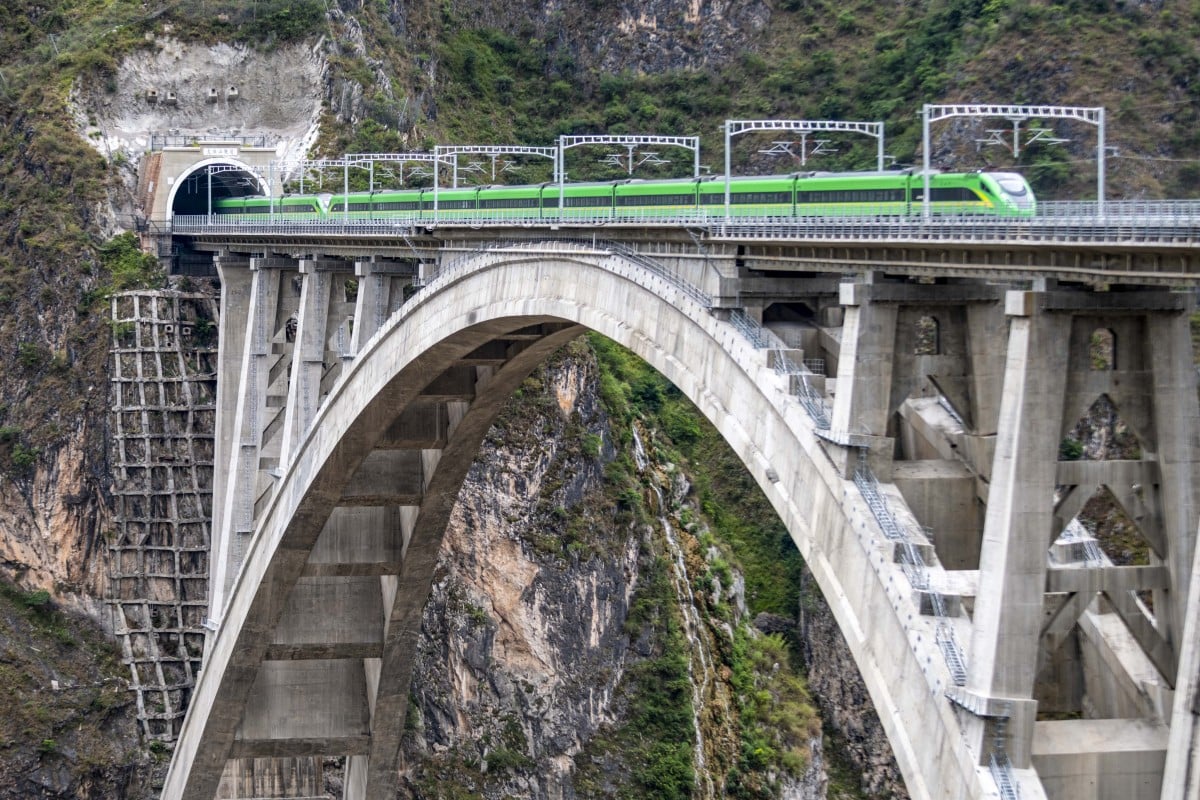
The line connecting Dali and border town Ruili in Yunnan province is the first to cut through the Hengduan Mountains, traversing some of the world’s most complex geological and topographical terrains.
Running along the country’s southwestern frontier for about 330km (205 miles), the railway is expected to boost China’s links with Southeast Asia.
The line is being built in two sections: Dali to Baoshan, and Baoshan to Ruili, a county-level city that serves as a major border crossing with Myanmar.
The first section broke ground in 2008 and was completed in 2022. The second half is now expected to be operational within five years, according to state media reports citing local officials.
Its completion will mark a milestone for global railway engineering.
The Dali to Baoshan section is a 133km journey that takes only about an hour. But it took tens of thousands of workers, 14 years to complete it because of the complex terrain.
By comparison, building a similar railway line across flat, geologically stable terrain would only take about three years.
When the section entered operation in July 2022, its builder, China Railway Group – one of the world’s largest construction and engineering contractors – described how challenging the project had been.
The company said that the line passed through areas characterised by steep mountains, deep valleys, intense tectonic activity and unstable, fractured rock formations. The construction had to avoid major fault zones and cross four large rivers.
This required building numerous technically demanding bridges and tunnels to support the railway. In total, 34 bridges and 21 tunnels were constructed.
The 14.4km Dazhushan tunnel alone, which cuts through six geological fault lines, encountered “almost every major engineering risk associated with large-scale tunnel construction” and took 12 years to complete, according to the company.
One of the biggest challenges was massive groundwater inflows. Water gushing into the tunnels equalled the volume of 156,000 standard swimming pools, forcing workers to labour in submerged conditions for extended periods.
Construction of the second section, from Baoshan to Ruili, began in 2015. Engineers are now tackling the project’s final and most formidable obstacle: the Gaoligong Mountain Rail Tunnel, a 34.5km stretch poised to be the longest such tunnel in Asia.
According to a December post on the Yunnan provincial government’s social media account, builders working 765 metres (2,500 feet) below the surface in the heart of the Hengduan Mountains are contending with extreme geothermal heat, high-pressure water inflows and fragile surrounding rock – challenges it described as “world class” in their difficulty.
“[It is] the world’s most difficult railway to build,” the post said.
On February 11, state news agency China News Service reported that the tunnel – regarded as the “throat project” of the railway – had reached only around half of its planned progress after nine years of construction. However, work is expected to speed up following recent technical breakthroughs.
The Baoshan to Ruili section of the Dali-Ruili Railway was among “projects set to be completed and opened” during the latest five-year plan period from 2026 to 2030, provincial newspaper Ethnic Times reported this month citing an official briefing.
Gao Shangjie, a senior engineer with a local transport bureau, told reporters last month that advances in tunnelling technology had significantly improved construction speed.
If all went to plan, the tunnel would be complete and operational by 2028, China News Service said.
The railway will transform transport in Yunnan’s mountainous west, cutting travel time from provincial capital Kunming to Ruili to 4½ hours – half the current nine.
As a key section of the China-Myanmar international railway corridor, the Dali-Ruili line would also “open a more efficient route linking China with countries in South and Southeast Asia”, China News Service said. — South China Morning Post