When a powerful earthquake struck Cebu in September 2025, the provincial governor made a single call to every mayor in the province.
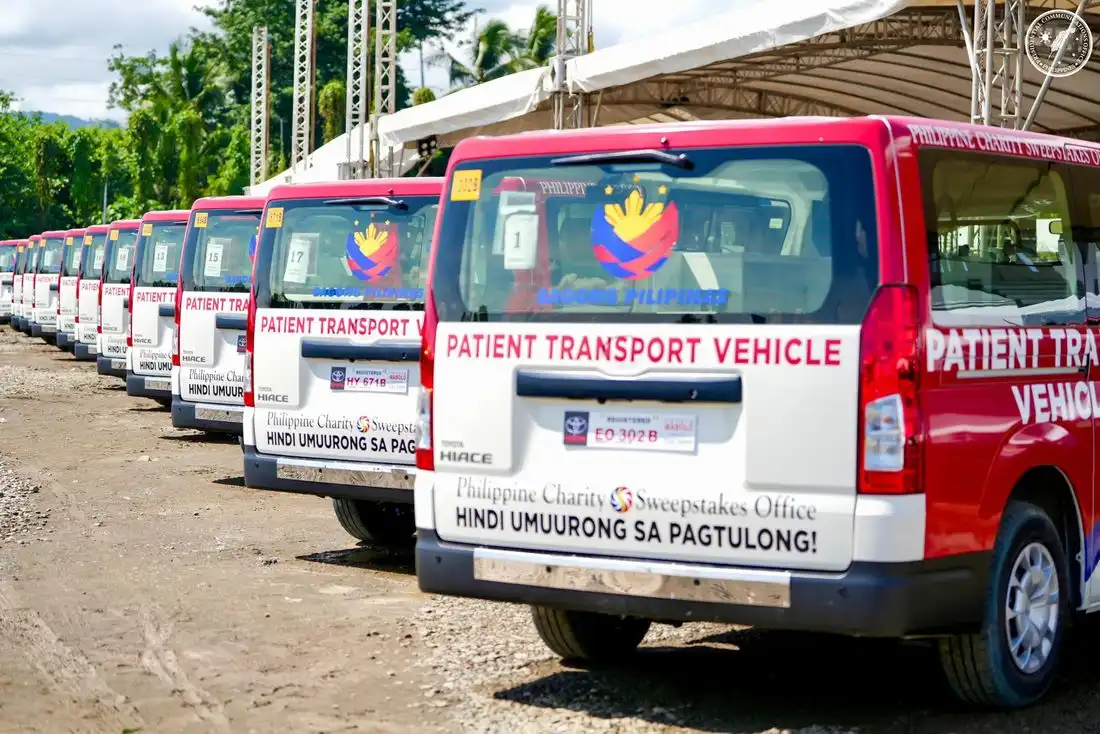
Because every municipality now had a PCSO patient transport vehicle, every single one was able to send an ambulance to the disaster site.
This produced what PCSO General Manager Melquiades “Mel” Robles said was the first mass mobilization of government ambulances in Philippine history.
Robles described the incident in an interview on DZRH News program Special on Saturday on September 19, saying the Cebu earthquake response demonstrated what becomes possible when universal distribution reaches every LGU.
The PCSO general manager said the scenario would have been impossible before the current distribution push: when fewer than half of Philippine municipalities had their own patient transport vehicle, a governor could not have issued that kind of call because most mayors simply had nothing to send.
“Since lahat po ng bayan ay meron na, nung nagkaroon po ng lindol ay napakarami pong kailangan, ang ginawa po ng Governor, tinawagan niya po lahat ng Mayor. Padala niyo yung inyong mga ambulansya,” Robles said.
He called it a “Bayanihan on Wheels,” a spontaneous, community-driven surge of resources that was enabled entirely by the fact that every municipality finally had an asset worth mobilizing.
“It has never happened before na ganyan klaseng response pero dahil sa lahat na sila meron, pinamobilize niya, pinapunta niya lahat sa site. ‘Yan po ang nakita namin na napakaganda po na bayanihan on wheels na po ‘yan talaga,” he said.
Robles said the Cebu experience has now become a playbook that other provincial governors can study and replicate.
With the possibility of formalizing it as part of provincial disaster drills, Robles said the coordinated dispatch of patient transport vehicles across municipalities can be rehearsed before a real emergency demands it.
The PCSO chief said the agency’s role in that scenario is the enabling condition, that by ensuring universal distribution, the agency created a reserve fleet of emergency vehicles that no previous government had ever assembled at the local level.