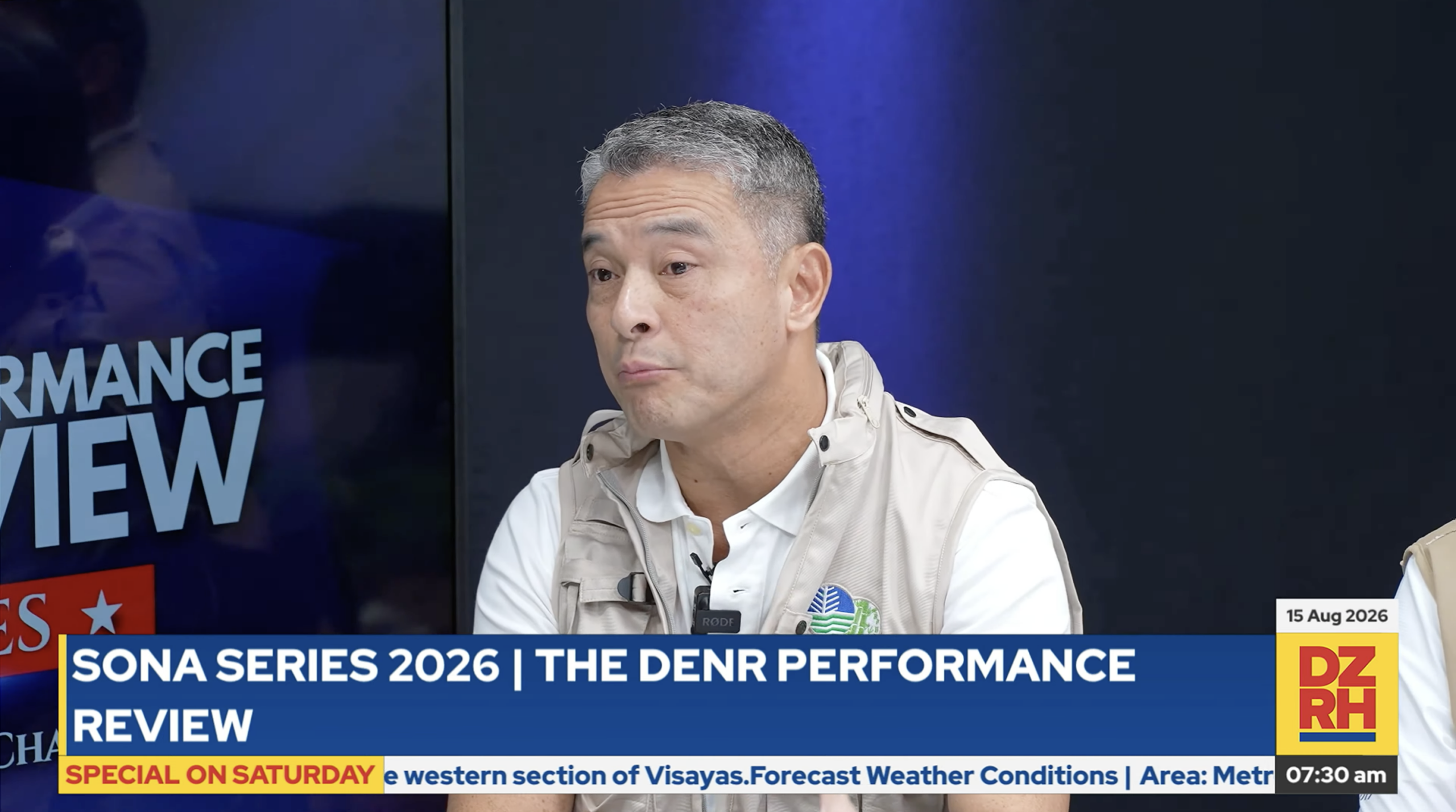
Twenty-five years after the Philippines passed its landmark solid waste management law, the country is now moving toward waste-to-energy technology as a complementary solution to its persistent garbage crisis, with a bill already approved by the House of Representatives and now being deliberated in the Senate, Environment Secretary Juan Miguel Cuna said Saturday.
Cuna made the statement in an interview on DZRH News program Special on Saturday on August 15, as part of the DZRH SONA 2026 Series featuring the Department of Environment and Natural Resources (DENR).
He said the National Solid Waste Management Act was passed in 2001, and that despite 25 years of effort and multiple approaches, the garbage problem remains visible and acute—as demonstrated by the garbage controversy in Metro Manila that drew President Ferdinand Marcos Jr.’s personal attention.
“25 years na po mula noong ipinasa ang batas, the National Solid Waste Management Act in 2001, and hanggang ngayon po eh the proof of the pudding is in the eating. Nakita natin ‘yung mga basura noong isang araw kung gaano kalala. So 25 years later, although marami nang effort lahat ng sector, nandito pa rin po tayo,” Cuna said.
He said President Marcos himself raised the possibility of waste-to-energy technology during the SONA and again during his visit to Parañaque, signaling that the administration is now seriously considering the approach as part of the solution.
Cuna said he personally visited a waste-to-energy facility in Paris as far back as 2016, and more recently visited five different facilities in Japan two years ago, and was impressed by the scale, cleanliness, and efficiency of the technology in both countries.
“The advanced and developed countries are using technology, that’s the way forward. Well, it’s one of the ways forward po,” Cuna said, acknowledging that waste-to-energy is not a complete solution on its own but a necessary complement to the 3Rs of Reduce, Reuse, and Recycle.
He said the DENR is preparing to monitor waste-to-energy projects once the enabling legislation is passed, and is engaging stakeholders—including those who have concerns about the technology—as part of an inclusive approach to finding a durable solution to the solid waste crisis.