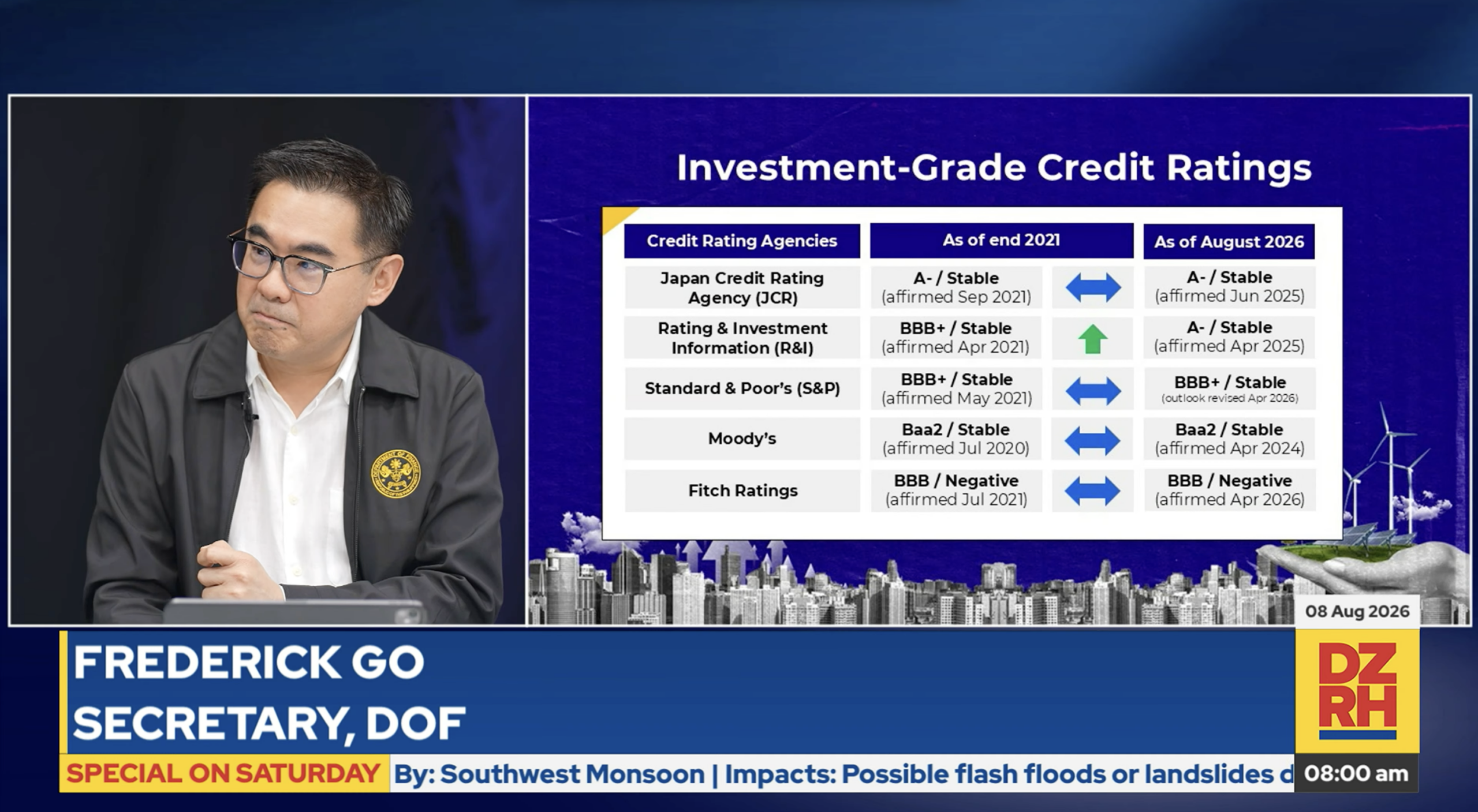
The Philippines has received investment-grade credit ratings from all five major global credit rating agencies, with two awarding an A- rating and three awarding BBB+, Finance Secretary Frederick Go said Saturday.
Go made the disclosure in an interview on DZRH News program Special on Saturday on August 8, as part of the DZRH SONA 2026 Series featuring the Department of Finance (DOF).
“Sa limang credit rating agencies, tatlo ay nagbigay sa atin ng BBB+. Dalawa nagbigay sa atin ng A-,” Go said, adding that a higher credit rating means the government can borrow money at lower interest rates from the global financial market.
“Kung humiram tayo ng pera sa mundo, for example, humiram tayo ng isang bilyong pesos. Kung ang credit rating mo siguro ay C, ang babayaran mong interest rate siguro ay 9%. Kung ang credit rating mo ay B, baka ang babayaran mo ay 7.5%. Kung credit rating mo ay A, baka ang babayaran mo ay 6%. Halimbawa lang, syempre nagbabago-bago po ito,” the Finance chief explained.
He explained the practical impact in plain terms: a country with an A rating might borrow at around 6% interest, while one rated C might pay 9%, meaning a higher rating directly reduces the government’s debt servicing costs.
Go said the ratings reflect the global financial community’s confidence in the Philippines’ economic management, fiscal discipline, and ability to repay its obligations consistently.
Undersecretary Joven Balbosa said the credit ratings were earned in part through the advisory and analytical support of multilateral institutions such as the World Bank and the Asian Development Bank, which helped translate their policy recommendations into concrete fiscal reforms.
Go said the investment-grade ratings across all five agencies also send a strong signal to foreign investors that the Philippines is a safe and stable destination for capital, reinforcing the gains from the CREATE MORE law and other investment-related reforms.
The improved credit ratings are expected to lower borrowing costs not just for the government but for all Filipinos, as banks pass on the lower cost of funds to consumers and businesses in the form of reduced interest rates on loans.