As the peso slides toward 62 to the dollar, an economist is pushing back against the instinct to treat currency weakness as a threat, arguing instead that a depreciated peso is one of the more reliable tools the Philippines has for generating jobs and reviving its long-stagnant export sector.
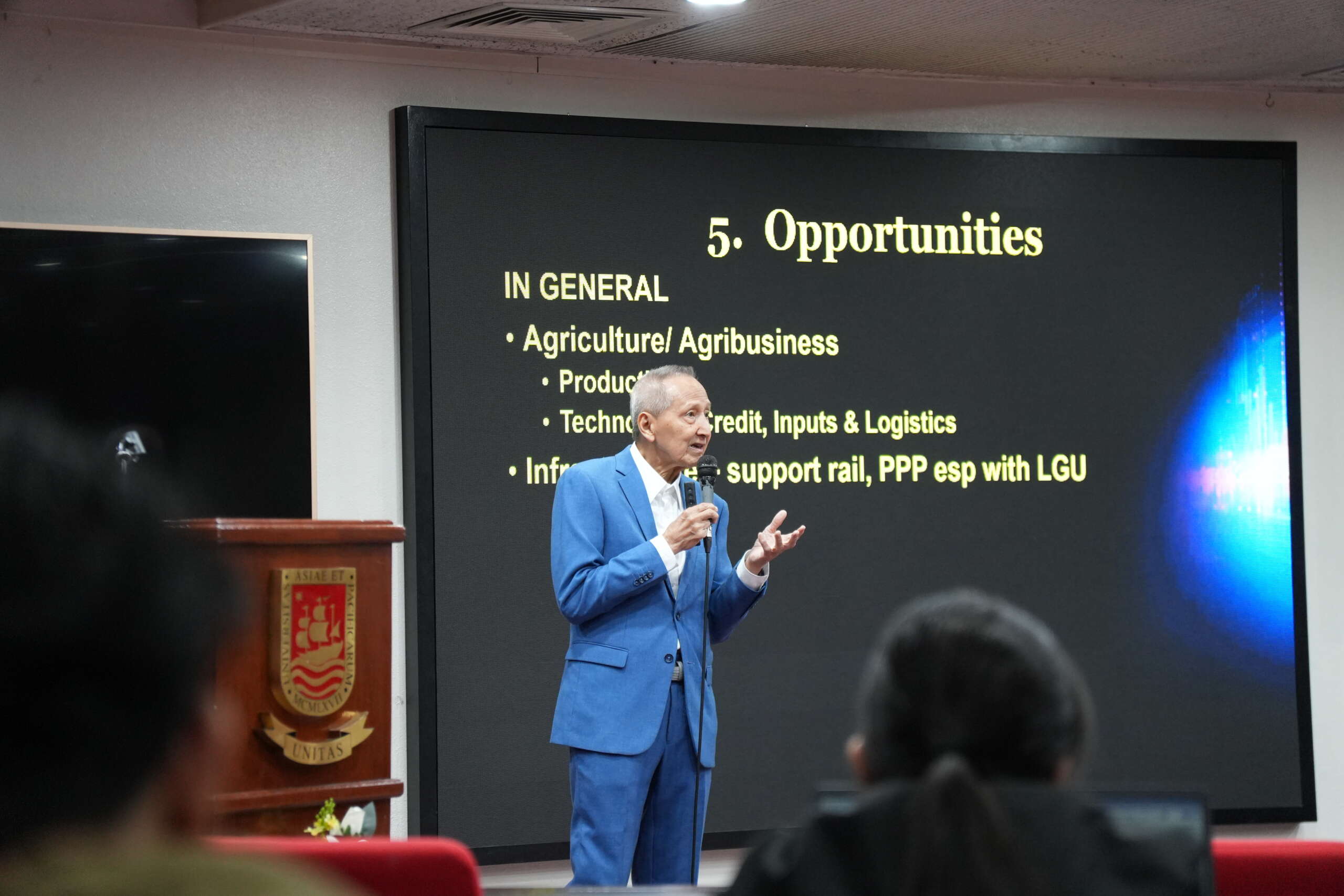
University of Asia and the Pacific (UA&P) Senior Economist Dr. Victor Abola made the case during a forum on macroeconomic prospects on Wednesday, April 29, drawing on decades of regional data to argue that the conventional fear of peso depreciation is misplaced.
“We should not fear currency depreciation,” he said. “A depreciated currency actually produces higher GDP growth and more employment.”
His argument rests on what a weak currency does to the cost structure of the economy. When the peso loses value, imported goods become more expensive relative to locally produced alternatives, which pushes consumers and businesses toward domestic products.
“Instead of importing, we will use local resources,” Dr. Abola said, “creating room for productivity and income in agriculture and domestic manufacturing.”
The economist backed his position with regional comparisons. He pointed to data showing that countries which kept their currencies deliberately undervalued over extended periods averaged GDP growth of 8.75 percent annually over roughly 24 years—a figure the Philippines has never come close to sustaining.
Vietnam, Malaysia, Indonesia, and Thailand all allowed their currencies to depreciate over long stretches, and their export sectors grew accordingly. Vietnam’s exports now stand at around $375 billion, he noted, while the Philippines will be fortunate to reach $80 billion this year.
The contrast with South Korea was even starker. In 1950, South Korea’s per capita income of $125 was lower than the Philippines’ $175. By 2023, South Korea’s per capita gross national income had reached $35,490 — more than eight times the Philippines’ $4,230.
Dr. Abola attributed much of that divergence to exchange rate policy. Korea kept its currency undervalued for decades, using export competitiveness as the engine of industrialization, while the Philippines maintained a relatively stable and appreciated peso for much of its modern history.
That appreciation, he argued, has been costly. The Philippines currently runs one of the largest trade deficits in the world in absolute dollar terms—sixth largest in 2024—despite having only the 32nd-largest economy.
“Our trade deficit means we are spending heavily on products produced abroad,” he said, “which means we are creating jobs abroad.” A cheaper peso, by making Philippine exports more competitive and imports relatively more expensive, works directly against that dynamic.
Dr. Abola also addressed the conventional worry that a weaker peso accelerates inflation. He acknowledged that depreciation does put upward pressure on prices, but argued the tradeoff is worth it.
“Conventional wisdom says it causes rapid inflation,” he said, “but a depreciated currency actually produces higher GDP growth and more employment.” His own year-end forecast puts the peso at 62 to the dollar — a level he does not view as cause for alarm, but as a potential catalyst for the kind of export-led growth the country has long failed to achieve.
The economist was careful to frame depreciation not as a magic solution but as a necessary condition for a structural shift—one that requires complementary moves in manufacturing complexity, agricultural productivity, and infrastructure.
Without those, he said, a cheaper currency alone will not close the gap with neighbors who used exchange rate flexibility as part of a deliberate, long-term development strategy. The peso’s slide, in his reading, is less a crisis than an overdue correction—and possibly an opening.