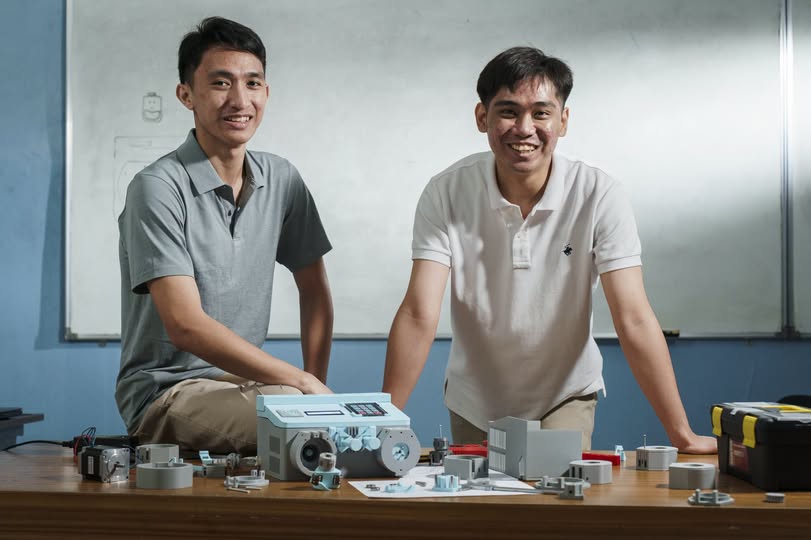
Two graduates from the University of the Philippines have won a national title in the James Dyson Award in the United Kingdom for developing a low-cost dialysis machine aimed at helping patients with chronic kidney disease (CKD).
Andrew Jacob Buensalido and Allyson Cabrestante created “BiDaKidney,” a low-cost, semi-automated peritoneal dialysis (PD) machine designed to improve access to treatment for CKD patients.
According to the James Dyson Award, the innovation was inspired by the plight of Filipinos, with around 2.3 million people living with CKD and facing limited access to dialysis services.
The “BiDaKidney” machine automates the flow and measurement of dialysis fluid using sensors adapted from existing commercial systems, the developers said.
Aside from being more affordable, the device allows patients to perform dialysis at home.
“BiDaKidney was designed for patients looking for an upgrade to manual PD by offering automated therapy at a price of around $100 — roughly 1% of the cost of commercial cyclers,” they said.
“Unlike machines that rely on specialized cassettes, BiDaKidney is compatible with inexpensive PD sets already used by patients, eliminating the need for costly consumables,” they added.
The developers also said the machine is lightweight, weighing about 2.5 kilograms, making it portable for use at home, school, or work.
They noted that while commercial automated peritoneal dialysis (APD) machines improve treatment quality and safety, their high cost remains a barrier.
“Commercial APD machines, while improving treatment quality of life and safety, cost upwards of $10,000 — unreachable for many, especially in developing countries,” Buensalido and Cabrestante said.
The UP graduates explained that “BiDaKidney” is intended as an upgrade to manual PD rather than a direct competitor to high-end machines, offering a middle ground between cost and convenience.
POSITIVE FEEDBACK FROM SPECIALISTS
The invention received positive feedback from peritoneal dialysis nurses and nephrologists from the Philippine Children’s Medical Center, particularly for its fluid automation system, according to the developers.
For future improvements, the team plans to add audio cues to signal the start and end of treatment sessions.
“We also plan to redesign the chassis for scalable manufacturing through processes such as vacuum casting and injection molding, integrate the electronics into a single printed circuit board to simplify assembly, and conduct formal clinical testing alongside broader patient evaluations to validate safety, performance, and user experience,” they said.
The project also won the Dr. Francis Chua Innovation Award, placing first in the 2026 University Project Competition — Design Category hosted by the UP Diliman College of Engineering.
The James Dyson Award also recognized “BiDaKidney” as the Best Capstone Project in the UP Department of Mechanical Engineering. — Photo from The James Dyson Award