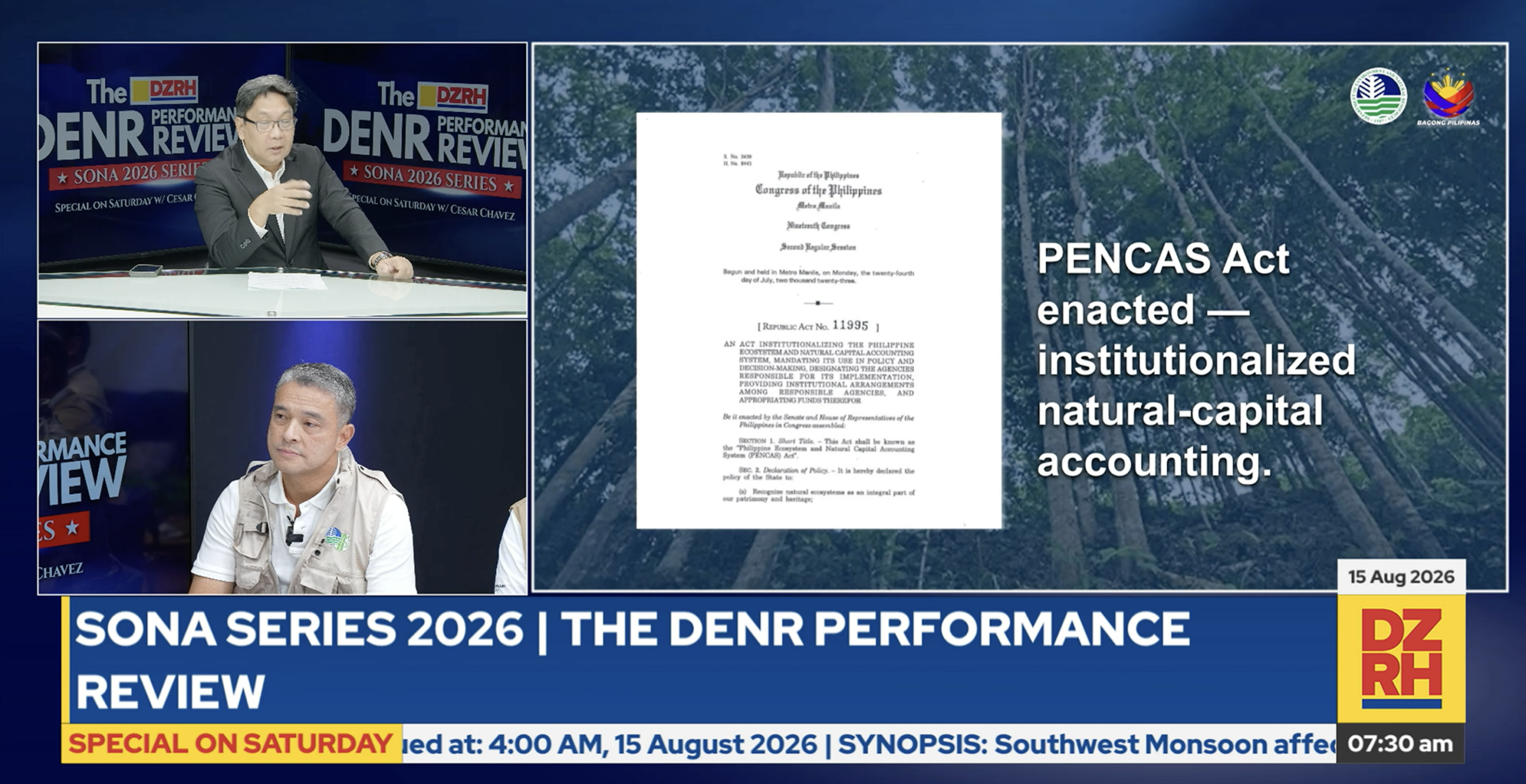
For the first time in Philippine history, the Philippine government now has a law that requires the systematic valuation of the country’s natural resources—not to sell them, but to understand their true worth so that economic planning and development decisions are guided by science rather than guesswork.
Environment Secretary Juan Miguel Cuna made the statement in an interview on DZRH News program Special on Saturday on August 15, as part of the DZRH SONA 2026 Series featuring the Department of Environment and Natural Resources (DENR).
The Philippine Ecosystem and Natural Capital Accounting System, or PENCAS, was signed into law by President Ferdinand Marcos Jr. in 2024, with Implementing Rules and Regulations already in place and agency capacitation underway.
“Ang kahalagahan po nito, katuwang po natin dito ang Philippine Statistics Authority. Ang DENR, ang kanyang tungkulin dito ay to gather all the statistical data about our natural resources, tapos ibinibigay po natin sa PSA at sila pong magko-collate nito, and then pag-aaralan ‘yung valuation,” Cuna said.
He said the valuation covers forests, minerals, biodiversity, water, and land—and goes beyond simply counting trees or measuring river flow to include the services these ecosystems provide to communities, such as flood prevention, water supply, and landslide mitigation.
“Pagdating sa forest po, pinag-aaralan ‘yung valuation niya. Hindi lamang kung anong maibibigay ng mga puno na nandoon. Sinasama po dito sa valuation na kung wala itong mga puno, anong mangyayari? Magkakaroon tayo ng mga landslide, makakasira ng mga properties,” Cuna said.
Undersecretary Jonas Leones said PENCAS transforms what were previously pilot studies and informal assessments into a systematic, nationwide, science-based accounting system that can inform decisions on competing land uses such as mining versus conservation.
He said the law also marks the first time the private sector has been formally integrated into environmental governance, with companies now required to take responsibility for managing their own environmental footprint rather than leaving it entirely to local governments.
Cuna said PENCAS values will also be incorporated into disaster risk and climate resilience planning, helping decision-makers understand the cost of losing a forest or a watershed not just in ecological terms but in lives and property damage prevented.
Assistant Secretary Michael Drake Matias of the Environmental Management Bureau said PENCAS will transform Environmental Impact Assessments by allowing agencies to quantify the actual economic impact of any proposed infrastructure or development project on the surrounding ecosystem, based on science rather than estimates.