For years, the Philippine justice system operated with too few prosecutors, too little training, and offices that barely reached beyond Manila, a combination that left millions of Filipinos, especially those in the provinces, waiting years for cases to move and justice to arrive.
Under the Marcos Jr. administration, the Department of Justice (DOJ) says it has begun to address all three gaps at once.
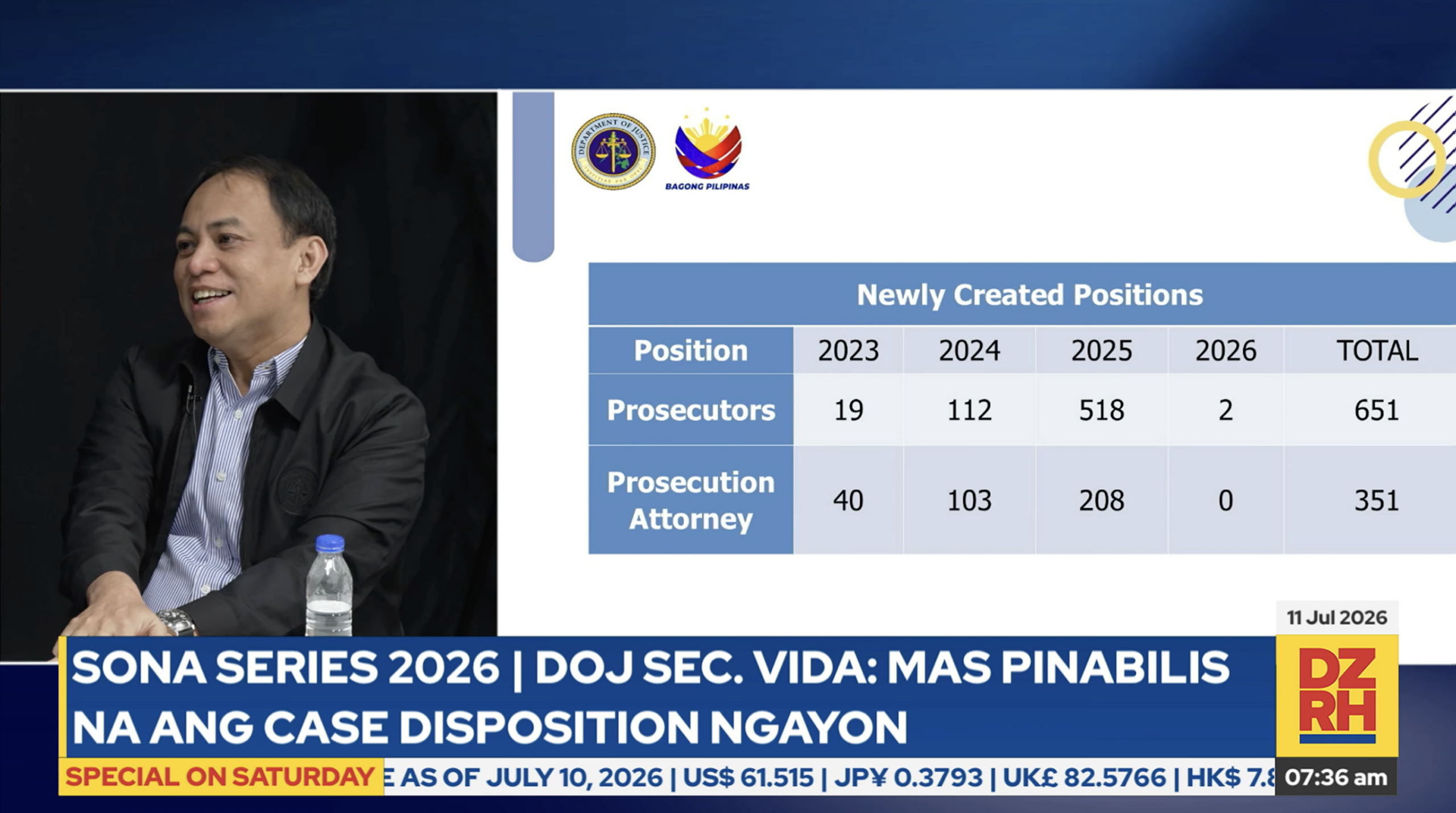
Justice Secretary Fredderick Vida told DZRH News program Special on Saturday on July 11, as part of the “The DZRH SONA 2026 Series,” that the DOJ has grown its prosecution force from 2,966 prosecutors in 2022 to 3,968—a 23.62% increase that includes both prosecutors and prosecution attorneys—with another 327 positions expected to be released by the Department of Budget and Management (DBM) in the third quarter of the year.
The expansion traces back to Republic Act 10071, a law passed in 2010 that mandated additional prosecutor positions—but was never funded for 14 years.
“Sa pangunguna po ng ating minamahal na pangulo, ngayon lamang nag-invest hindi lang sa human resource, pati rin para sa office space, pati sa training,” Secretary Vida said.
Undersecretary Anika Gran-Ong said the department also made a ₱1 billion investment in personnel training under the current administration — the first time in DOJ history that every fiscal, official, and personnel could be trained at least once a year in a training relevant to their specific role.
“Dati ‘yung Department of Justice has been operating under limitation—in terms of manpower resources, organizational support. With that, this administration nag-invest po ang ating gobyerno sa ating Department of Justice,” Undersecretary Gran-Ong said.
She said the breakdown of new prosecutor positions shows the scale of the effort: 518 new prosecutor positions were created in 2025 alone, alongside 208 new prosecution attorney positions in the same year, with a total of 898 prosecutors appointed from 2024 to 2026.
Beyond numbers, the DOJ has also extended its geographic reach, opening three new regional prosecution offices—in MIMAROPA based in Palawan, the Cordillera Administrative Region based in Baguio, and the Negros Island Region based in Bacolod—consistent with the national government’s expansion from 15 to 18 regions.
Secretary Vida said the impact on the ground is already being felt in the provinces, where a single fiscal previously handled as many as five or six courts—a workload that made fast justice almost impossible.
“Konti lang talaga ang prosecutor dun dati. ‘Yung mga ratio dun, mga one is to five courts, one is to six courts. So kung ganun, mabagal ang takbo ng mga kaso,” Undersecretary Ty said.
The National Prosecution Service resolved 99.77% of its total caseload in 2025, up from 98.72% in 2024, while the conviction rate rose to 90.84% in 2025 from 90.13% the previous year—figures that Secretary Vida said reflect not just more prosecutors, but better-prepared ones.