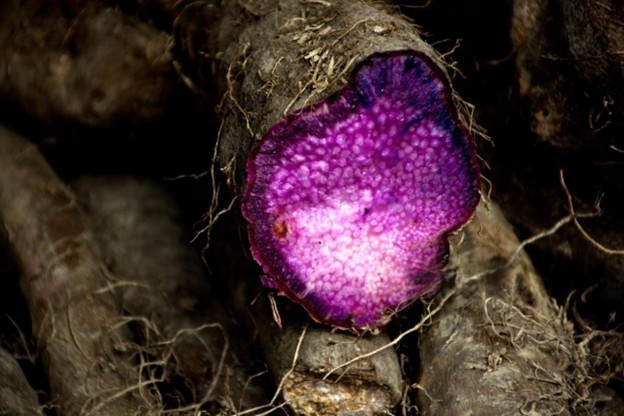
Purple yam, locally known as “ube,” is emerging as a rising export product for the Philippines, gaining global attention as demand for the crop continues to grow, according to the Department of Trade and Industry (DTI).
Trade Secretary Cristina Roque said exports of ube, along with other agricultural products, are showing steady growth.
While coconut remains the country’s “superstar” export commodity — backed by decades of strong global demand — Roque noted that ube is increasingly making its mark in international markets. She added that coconut exports recently recorded a 34% increase.
But, the trade secretary added other agricultural products are also making waves in the export sector such as ube.
Rising demand for ube
Data from the DTI’s Export Marketing Bureau showed that in 2025, ube-based product exports reached $3.06 million, with most shipments bound for the United Kingdom, United States, Italy, and countries in the Middle East.
The DTI reported steady growth in processed ube products, including ube powder, puree, halaya, and flavor extracts. Global manufacturers are also increasingly incorporating ube into products such as ice cream and baked goods, reflecting rising international interest.
With this trend, the agency aims to further expand ube exports, alongside other high-potential agricultural products. Roque added that ube, along with calamansi, is among the country’s most in-demand export goods.
To support this growth, the DTI said it will continue assisting micro, small, and medium enterprises (MSMEs) and farmers to boost ube production.
Boosting local production
Despite its growing popularity abroad, ube production in the Philippines has faced challenges in recent years.
The Department of Science and Technology (DOST) earlier noted a decline in output. Data from the Philippine Statistics Authority (PSA) showed that ube production dropped to 14,000 metric tons in 2020 — more than 50% lower than the 30,074 metric tons recorded in 2006.
Among all regions, Bohol remains the country’s largest producer, accounting for about 35% of total output.
However, Marlon Tambis, director of the Philippine Root Crop Research and Training Center, said farmers in Bohol continue to face challenges, particularly the lack of quality planting materials.
“Based on our scoping studies, their production practices are not very scientific. There is low adoption of recommended science- and technology-based practices, which we need to address to improve yield,” Tambis said.
To address these gaps, the Philippine Root Crop Research and Training Center of the Visayas State University, in partnership with Bohol Island State University, has introduced advanced propagation techniques for ube farmers.
These include the “minisett” method, a rapid propagation technique for yams that involves cutting a healthy tuber into smaller pieces. While traditional methods yield only seven to 10 planting materials per kilo of ube, the minisett method can produce more than 30.
Tambis explained that these smaller planting materials require careful preparation, including initial germination in seedbeds before being transferred to the field.
Researchers are also developing tissue culture techniques to produce large volumes of high-quality planting materials in the future.
“Tissue culture will be a big help. We are targeting to produce millions of planting materials next year, but we are still establishing the necessary hardening protocols,” Tambis said.
Seasonal challenges and innovations
Aside from limited planting materials, ube farming is constrained by seasonality. Traditionally, ube is planted only between May and June.
However, researchers have identified varieties suitable for year-round cultivation, including Baligonhon, Inoringnon, Kabus-ok, Zambal (VU2), and the well-known Ubi Kinampay, prized for its aroma, color, and taste.
Tambis said new techniques now allow planting as early as February by overcoming dormancy and improving germination methods.
“So far, we have demonstrated that breaking dormancy and propagation outside the natural growing season is possible,” he said.
The DOST said these innovations could help the Philippines meet rising global demand for ube, provided farmers adopt improved technologies and modern production practices.
Experts added that expanding ube production not only strengthens export potential but also provides greater economic opportunities for farmers and rural communities. — Photo from DOST