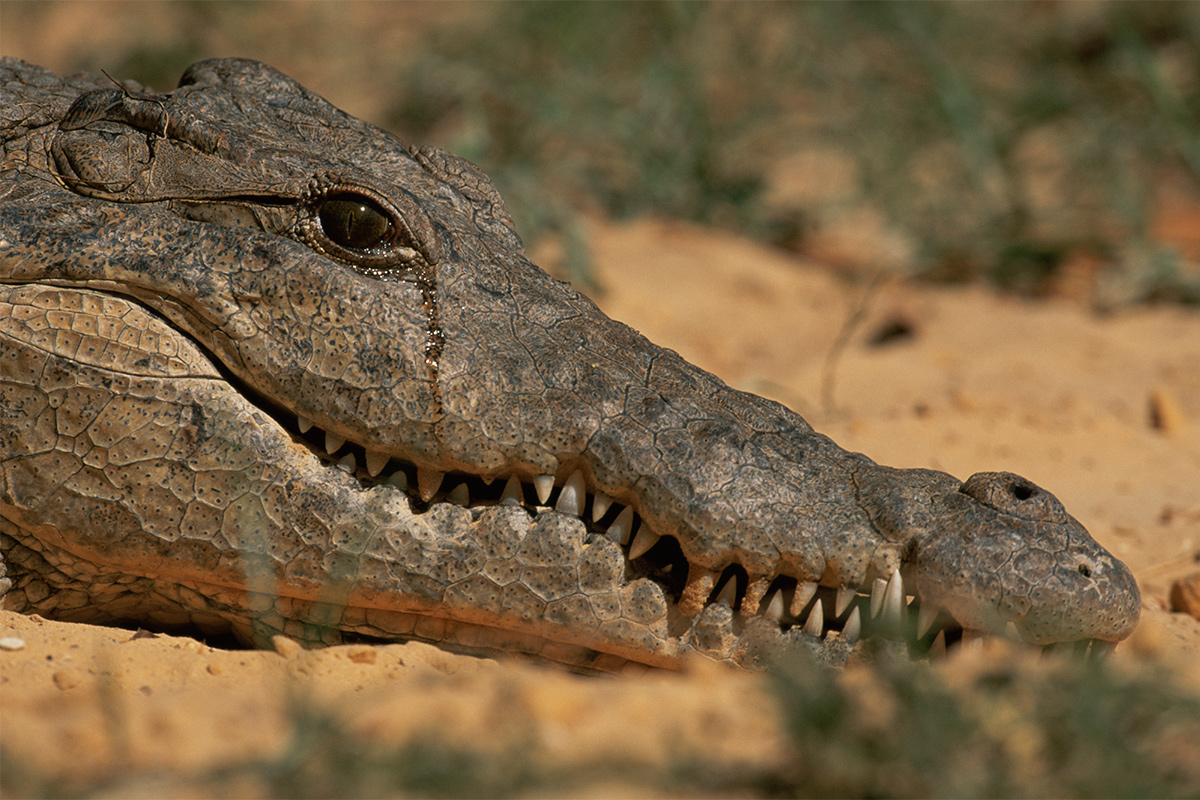
Do crocodiles cry? Science says yes — but not for the reasons long suggested by myth and folklore.
A 2007 study published in the journal BioScience found that crocodiles do produce tears while feeding, challenging the age-old belief that “crocodile tears” signify emotional remorse or sorrow.
The study, titled “Crocodile Tears: And thei eten hem wepynge,” was co-authored by Dr. D. Malcolm Shaner, a clinical neurologist at the University of California, Los Angeles, and Kent A. Vliet, a zoologist at the University of Florida. It provided the first documented, video-recorded evidence of mealtime lacrimation, or tearing, in crocodilians.
The research was initiated by Shaner, who treats patients with Bogorad’s syndrome — a rare condition commonly known as “crocodile tears syndrome.” The disorder often develops after facial paralysis and causes individuals to shed involuntary tears while eating due to misdirected lacrimal nerve pathways.
Seeking to determine whether the medical term had a basis in reptile biology, researchers conducted controlled observations on captive crocodilians.
To test the premise, the team videotaped seven reptiles at the St. Augustine Alligator Farm Zoological Park in Florida. The subjects included three American alligators, three common caimans, and one yacare caiman.
The animals were trained to feed on dry land rather than in water to ensure that any moisture observed around the eyes was due to ocular secretion, not splashing. They were fed a diet of quail, chicks, and commercial pelletized alligator feed.
Researchers observed distinct tearing, bubbling, or foaming in five of the seven animals immediately before, during, or after feeding. In one case, a common caiman developed foam in its left eye about 40 seconds after feeding began, which dissipated after roughly 20 minutes.
A 3.5-meter male American alligator also exhibited eye glistening and bubbling even before food was presented, apparently in anticipation after observing another animal feed. Meanwhile, one common caiman and the yacare caiman showed no signs of tearing.
The researchers concluded that these eye secretions serve a physiological function and are not linked to emotional distress or grief.
Instead, the phenomenon appears to be caused by the physical exertion involved in feeding — including hissing and forceful breathing — which affects the animals’ sinus system. Crocodilians possess an expanded lacrimal sinus network connected to the nasopharynx; pressure from feeding movements likely stimulates the lacrimal glands, resulting in tear production.
Similar tearing and bubbling were also observed during non-feeding activities involving intense exertion, such as territorial displays and courtship behavior, further supporting the biological explanation.
The findings suggest that while crocodiles do produce tears, the behavior is rooted in anatomy and physiology — not emotion — offering a scientific explanation behind one of the most enduring expressions in language. — Photo from corbis