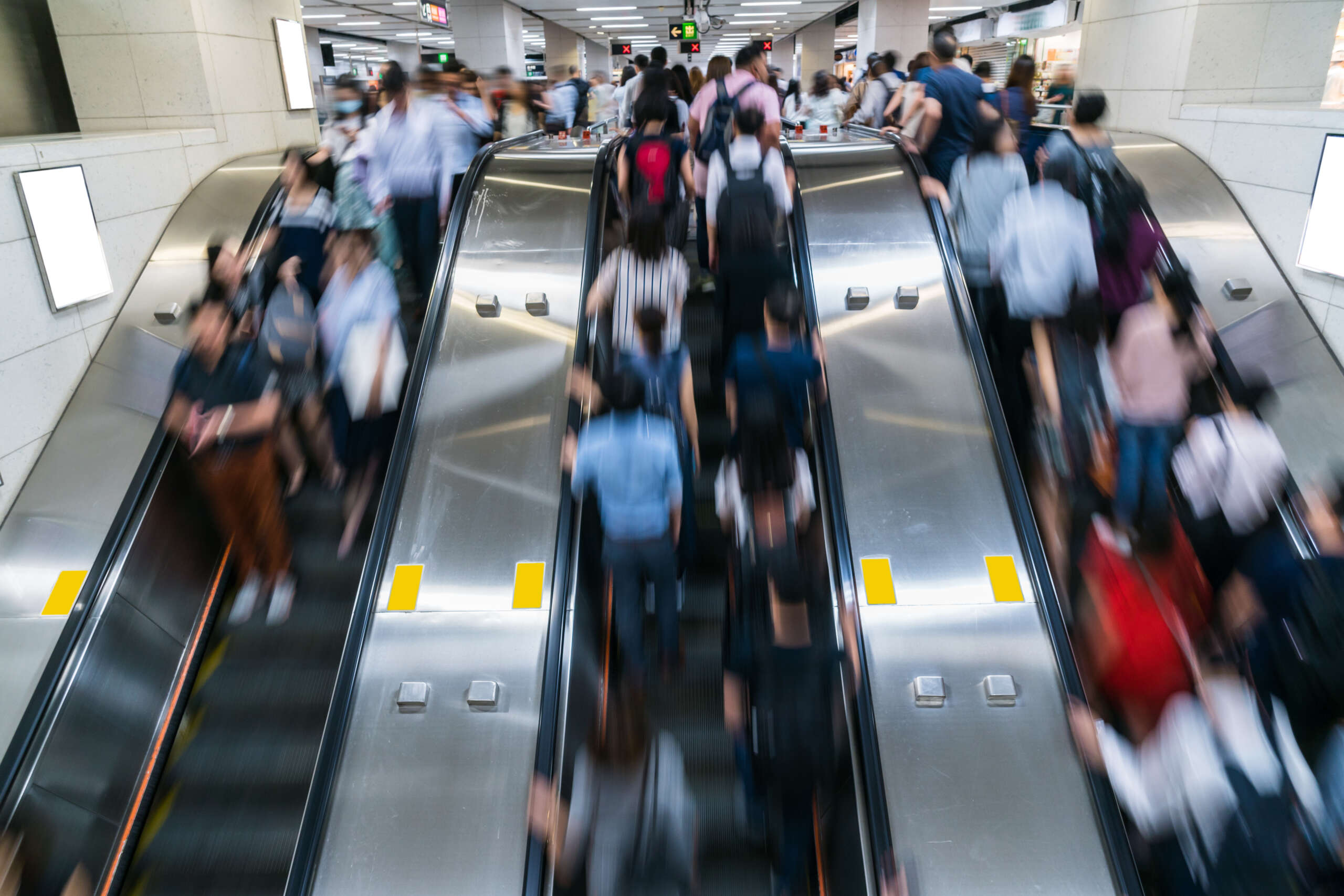
For decades, the etiquette to “stand on the right and walk on the left” on escalators has been treated as an unwritten rule of urban courtesy, but transit authorities and safety experts across Asia, Europe, and North America are now openly questioning whether the practice is unsafe, inefficient, and damaging to escalators.
Reports by the Bay Area Rapid Transit (BART) in San Francisco, United States have pointed to uneven passenger loading as a major factor in frequent escalator breakdowns, with officials warning that concentrating weight on one side accelerates mechanical wear.
BART officials explained in interviews cited by local media outlet ABC7 News that habitual standing and walking on one side can gradually cause a “tilt” in escalators, leading to misalignment that increases the likelihood of malfunctions and prolonged shutdowns.
Similar concerns have been raised in China, where Nanjing Metro authorities said about 95 percent of severe escalator wear was found on the side where passengers traditionally stand or walk, according to reporting by the South China Morning Post.
In Japan, the Asahi Shimbun reported that Saitama Prefecture enacted the country’s first ordinance requiring passengers to stand still on escalators, after officials cited injury data and safety studies showing that walking increases the risk of falls.
The Japan Elevator Association has also warned that escalators are not designed to anticipate sudden movement, noting that walking introduces jolts and shifts in balance that can strain internal components and endanger riders.
In Hong Kong, data released by the MTR Corporation and cited by the South China Morning Post showed that a significant portion of escalator accidents involved passengers who were moving, distracted, or carrying heavy items while walking.
Beyond safety, congestion studies have challenged the assumption that walking saves time, with The Guardian reporting that trials by London Underground found that standing on both sides increased escalator throughput by nearly 30 percent during rush hour.
Transport planners involved in the London trial said reserving one side for walkers left much of the escalator unused, creating bottlenecks below that placed heavier stop-start pressure on the machinery.
In Beijing, Beijing Review reported that subway operators have introduced small footprint stickers on escalators to signal that passengers may stand side-by-side, reinforcing guidance adopted in 2018 when Beijing Subway formally dropped the “right and left” recommendation.
Writing in Workers’ Daily, commentator Jiang Debin said escalators were never intended for pedestrian traffic and that prolonged weight on one side hastens mechanical deterioration, increasing the risk of equipment failure and safety hazards.
Psychologists quoted by The New York Times noted that social pressure and fear of appearing inconsiderate often keep commuters following the old etiquette, even as more cities abandon it in favor of standing still and holding the handrail.