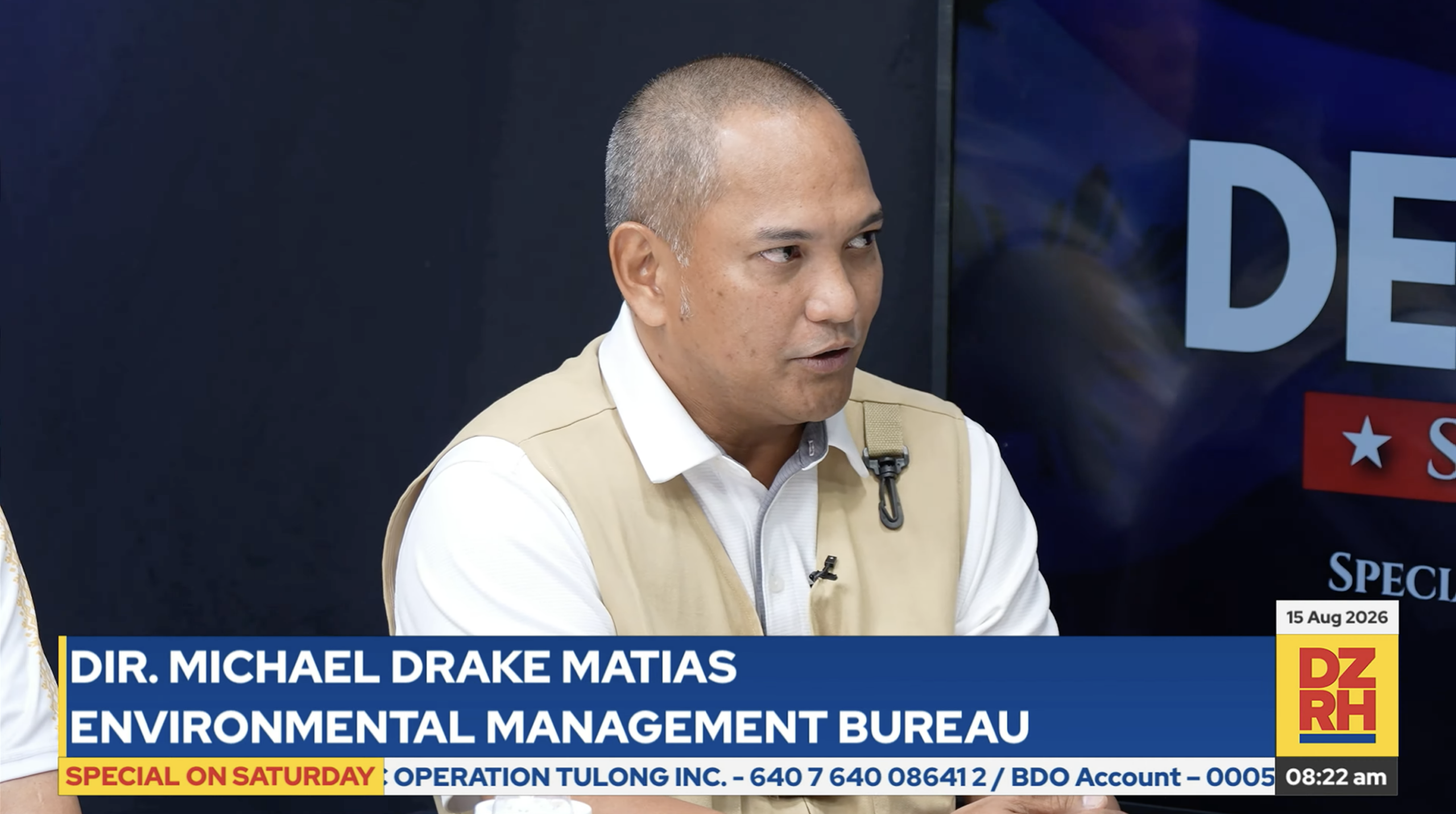
About 89% of local government units across the Philippines now have Solid Waste Management Plans approved by the Department of Environment and Natural Resources (DENR), a significant increase from previous years, but Environmental Management Bureau (EMB) Director Michael Drake Matias said they are moving to make sure the plans are fully implemented.
Matias made the statement in an interview on DZRH News program Special on Saturday on August 15, as part of the DZRH SONA 2026 Series featuring the Department of Environment and Natural Resources (DENR).
He said the number of LGUs with approved plans has grown by 328 under the Marcos administration, reflecting the department’s active push for compliance with the National Solid Waste Management Act.
“Pagdating po doon sa mga plans, nabanggit po natin kanina na mayroon tayong during the time of President Marcos, additional 328 approved plans po ng mga local government units. Pero hindi po ibig sabihin na compliant sila sa plano, compliant na rin po sila pagdating sa pagsunod sa batas,” Matias said.
DENR Undersecretary Jonas Leones said the gap between plan approval and actual implementation stems from the limited resources and technical capacity of many LGUs, particularly those in lower income classifications that cannot afford the equipment, facilities, or personnel needed to run a proper solid waste management program.
He said the Marcos administration has addressed this gap in part through the EU Green Economy Program, a €60 million grant specifically designed to capacitate LGUs on how to implement their Solid Waste Management Plans and provide them with necessary equipment.
Leones said the DENR’s role under the law is primarily for education, technical assistance, and capacity building, with the actual implementation and enforcement of solid waste management falling squarely under the mandate of each local government unit.
Environment Secretary Juan Miguel Cuna stressed that the 3Rs — Reduce, Reuse, Recycle — remain the foundation of solid waste management, and that solutions must start at the household and barangay level before they can scale up to address the larger crisis visible in Metro Manila’s waterways during heavy rains.