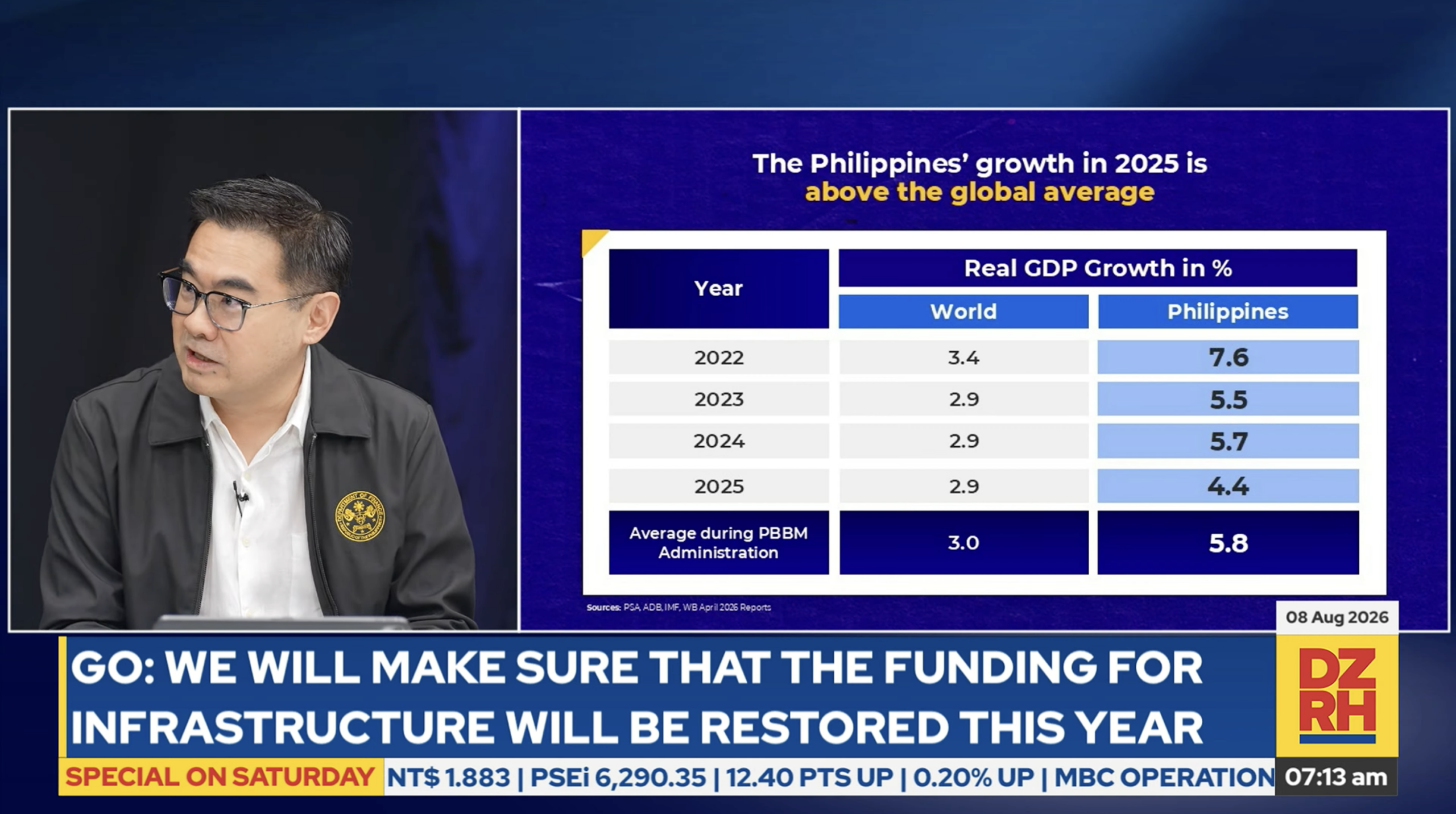
The Philippine economy grew at an average of 5.8% annually over the past four years under President Ferdinand Marcos Jr., more than double the global average of 2.5% to 3%, Finance Secretary Frederick Go said Saturday.
Go made the disclosure in an interview on DZRH News program Special on Saturday on August 8, as part of the DZRH SONA 2026 Series featuring the Department of Finance (DOF).
“During the last four years of the Marcos administration, our GDP growth averaged at 5.8%. To put this into perspective, the rest of the world, ang buong daigdig na ito, ang GDP growth nila ay mga 2.5% to 3% lamang,” Go said.
He acknowledged that growth slowed in the period since the President’s last State of the Nation Address (SONA), primarily due to reduced public spending, and said the government is actively restoring infrastructure expenditure in the second half of 2026 to reverse the slowdown.
“We are going to make sure that in the second half of this year, the public spending, particularly on infrastructure, will be restored,” Go said.
Finance Undersecretary Joven Balbosa said the single biggest driver of the Philippines’ above-average growth has been the dramatic increase in infrastructure spending, which rose from 1 to 2% of GDP to 5% or more under the Marcos administration.
Finance Undersecretary Karlo Fermin Adriano added that the CREATE MORE law, which expanded incentives for foreign investors, also contributed by making the Philippines more competitive against regional peers such as Vietnam, Thailand, and Indonesia.
Go said the country’s growth trajectory is expected to resume, projecting GDP growth of 5% to 6% for both 2027 and 2028, supported by continued infrastructure spending and sustained investment inflows.
“The country, starting in 2027 will resume that path. We will continue to grow again at 5% to 6% for 2027, 2028,” Go said.
He said the Philippines’ economic performance over the past four years demonstrates that sound fiscal management, sustained public investment, and investor-friendly reforms can deliver above-world-average results even amid global headwinds such as the Iran-US conflict and elevated energy prices.