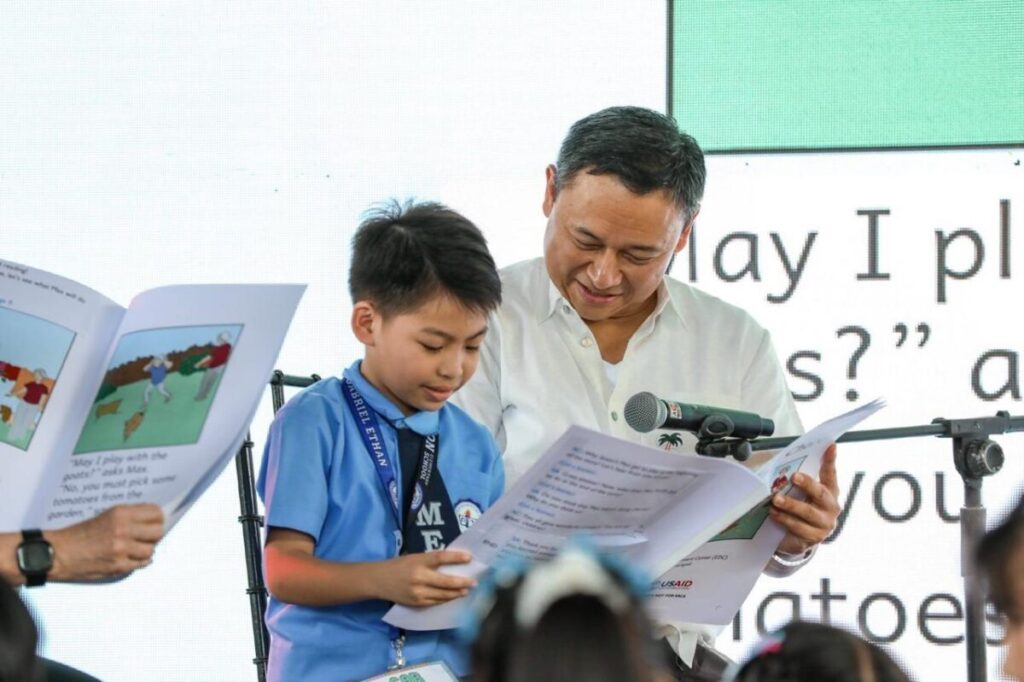
President Ferdinand Marcos Jr. has directed that every public school student must have their own personal textbook to write on and keep, just like in private schools—a policy that ends decades of shared, untouchable textbooks in Philippine public education, Education Secretary Sonny Angara said Saturday.
Angara made the statement in an interview on DZRH News program Special on Saturday on August 1, as part of the DZRH SONA 2026 Series featuring the Department of Education (DepEd), alongside a historic jump in the textbook budget and the fastest textbook procurement in department history.
“Sabi niya dapat isang bata, isang textbook, kanya ‘yun. Pwede niyang iuwi ‘yun, pwede niyang sulatan ‘yun. Parang private school,” Angara said.
He said research shows retention increases by two-thirds when a student writes in their own materials, making the shift from shared, untouched books to personal workbooks a learning intervention as much as a supply reform.
The textbook budget has grown from ₱3 billion—and as low as ₱1 billion during the COVID-19 pandemic—to ₱19 billion, the biggest ever, while in the 10 years before the Marcos administration only 27 textbook titles were procured.
“In the past three years, nasa 80 to 90 titles na po ang na-procure namin,” Undersecretary Fatima Panontongan said.
For the first time in Philippine history, DepEd is on track to complete a full set of textbooks covering all subjects from Grade 1 through Grade 12, with Early Procurement Authority already secured to ensure the process is completed before the next school year begins.
The new policy also removes teacher accountability for lost or damaged textbooks—ending a longstanding source of stress for teachers who previously had to account for books lost by students through no fault of their own.
Undersecretary Edson Byron Sy summarized the textbook reform: bigger budget, faster procurement, and for the first time, workbooks that students can write on, take home, and keep as their own.
Angara said the convergence of one-student-one-textbook, ARAL tutorials, and universal feeding means public school students are now enjoying benefits that previously only private school children could access.