The superintendent of the Philippine Merchant Marine Academy (PMMA) backed a proposal for President Ferdinand Marcos Jr. to issue an executive order automatically classifying the country’s approximately 400,000 active seafarers as military reservists, modeled after the United States’ “7th Service” Merchant Marine Service, even as no legislator has yet taken up the measure.
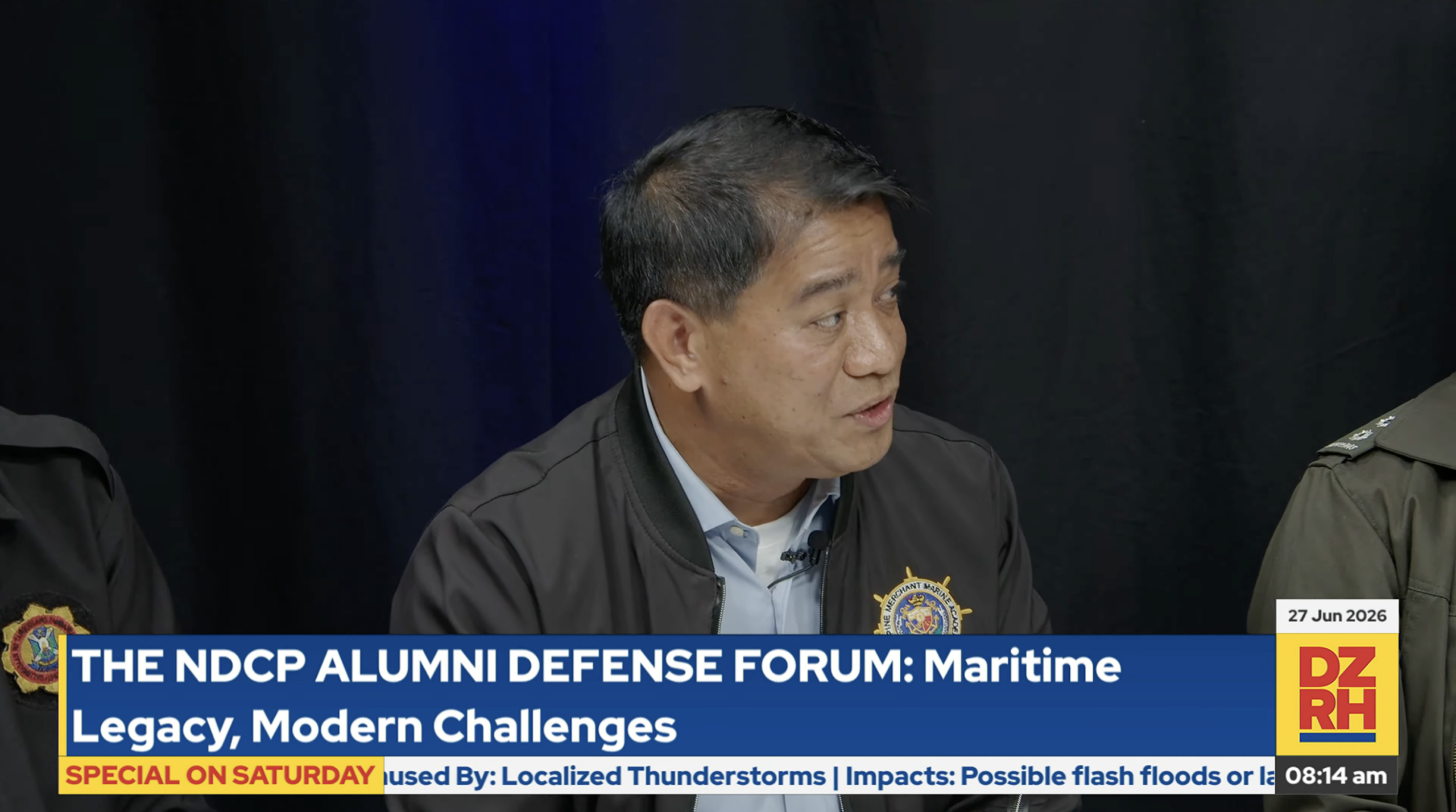
The proposal was raised during the National Defense College of the Philippines Alumni Association Inc. Annual Defense Forum, aired on DZRH News program Special on Saturday on June 27, where it was floated that an executive order—and eventually a law—could formally designate active seafarers as reservists, complete with certification and civil service eligibility.
Former Defense Secretary Norberto Gonzales set up the discussion by pointing to a policy gap, arguing that seafarers already possess real, internationally validated technical competence through their work abroad, making them ideal candidates for reservist status without requiring extensive additional training.
“Pero what’s lacking is the policy,” Gonzales said, before the specific executive order proposal was put forward: “You have 400,000 seafarers, hindi ba pwedeng executive order lumabas, if not a law later, na ‘Oh, ito, reserve na sila.’ ‘Pag seafarer ka na, you will be given a certificate na dahil nag-seafarer ka na, may actual technical competence ka.”
PMMA Superintendent Commodore Joel Abutal endorsed the proposal without hesitation. “Absolutely, yes,” Abutal said.
Coast Guard Auxiliary Commodore Jeremias Simon, president of the alumni associations of NDCP and PMMA, cited the US model as a template the Philippines could follow, noting that the Merchant Marine Service is formally recognized as the “7th Service” of the United States alongside the Air Force, Marines, Navy, and Army, complete with legal backing that compels service during wartime.
“Just like in the United States, just like in Japan, there is what we call a Merchant Marine Service or the 7th Service of the United States. It’s a policy, it’s a law. Meaning ‘pag nagka-giyera, you’re compelled to join,” Simon said.
Abutal noted that beyond the 400,000 active seafarers, the Philippines has approximately 1.8 million seafarer graduates overall, representing a vast pool of trained maritime personnel—masters, chief engineers, port supervisors, and executives working across the globe—that he described as an overlooked strategic asset for the country’s defense posture.
“These are the strategic power na na-overlook natin kasi they are a reserve force. We can mobilize,” Abutal said.