The Philippine Institute of Volcanology and Seismology (PHIVOLCS) is urging all Filipinos to participate in a nationwide earthquake drill scheduled on June 18, with its director emphasizing that the exercise is most effective when paired with structurally sound buildings and a genuine culture of preparedness at the community level.
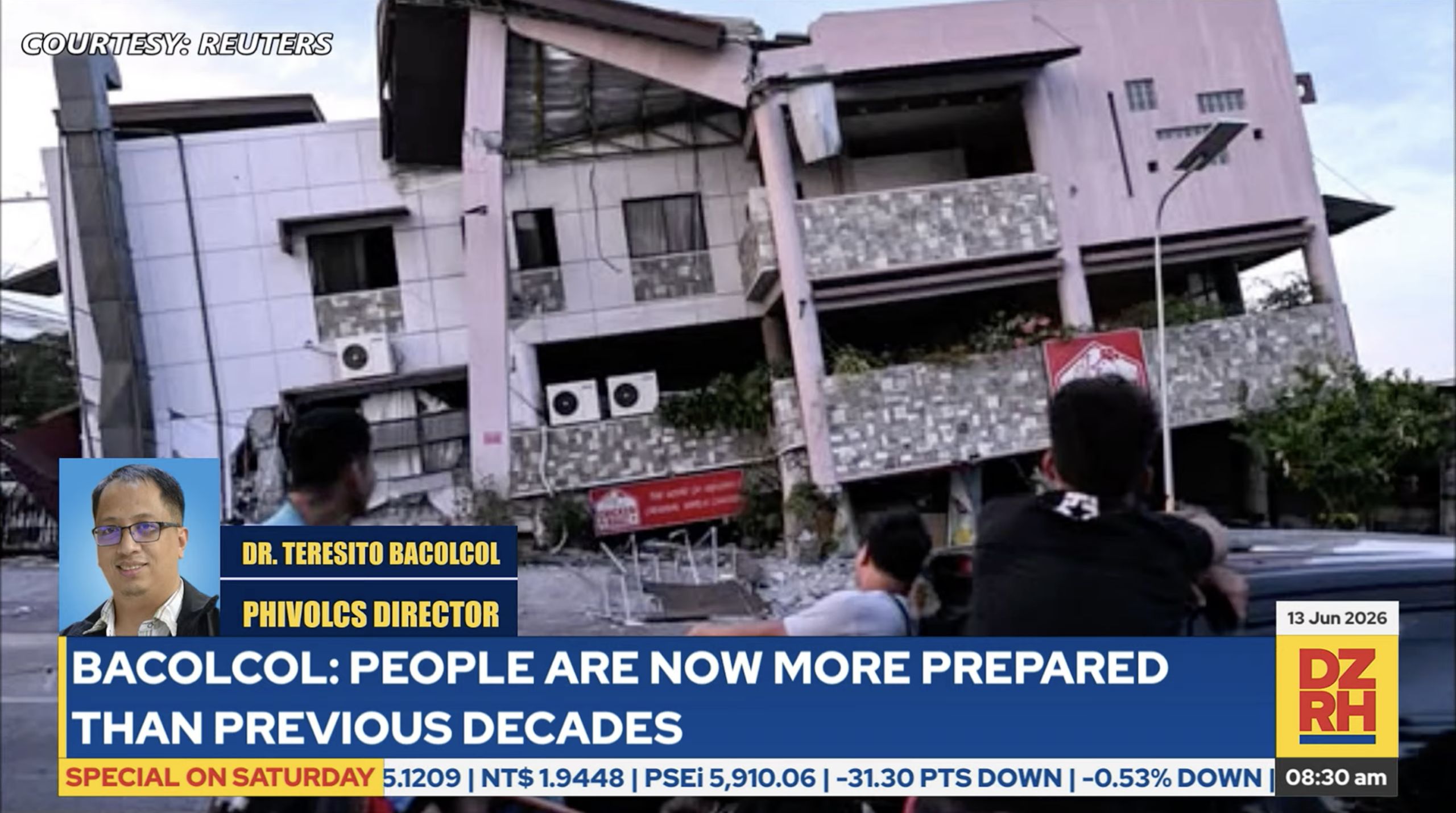
PHIVOLCS Director Teresito Bacolcol made the call in an interview on DZRH News program Special on Saturday on June 13, just days after the June 8 magnitude 7.8 earthquake struck Southern and Central Mindanao, killing at least 46 people, injuring 688, and leaving 38 missing.
“Next week meron naman tayong earthquake drill, June 18. I hope everybody will participate,” Bacolcol said, adding that the drill is designed to teach the public the correct response during shaking—to drop, take cover under a table, and hold on until the tremors stop.
He said the duck-cover-hold protocol taught in earthquake drills is a critical first step, but cautioned that its effectiveness is limited if the building a person is inside is not compliant with the national building code.
“The thing with the earthquake drill, again, tinuturuan tayo kung anong gagawin natin during the shaking, magtago tayo sa ilalim ng table. But the thing is, hindi pa rin ‘yan guarantee kasi kahit mag-duck, cover, and hold tayo, kahit na-master na natin ‘yung duck, cover, and hold, kapag gumuho ang maliit na bahay natin, hindi pa rin gaano effective,” Bacolcol said.
He said preparedness is not solely the responsibility of PHIVOLCS, the Office of Civil Defense, or the National Disaster Risk Reduction and Management Council, but a collective duty shared by every Filipino—from households to local government units.
“Preparedness is not just the business of our institute or business of OCD or NDRRMC, it is everyone’s collective duty to prepare,” Bacolcol said.
Bacolcol said families should practice duck-cover-hold at home with their children, participate in community drills, and be aware of the structural condition of the buildings they live and work in—particularly older structures built before 2000, which predate updated seismic engineering standards.
The June 18 drill comes as aftershocks from the June 8 Cotabato Trench earthquake continue, with 4,554 tremors recorded as of 7:00 AM Saturday, though Bacolcol said daily counts are on a clear downward trend and are expected to continue tapering off.
The Philippines sits within the Pacific Ring of Fire and is surrounded by six active trenches—the Philippine Trench, East Luzon Trough, Manila Trench, Negros Trench, Sulu Trench, and Cotabato Trench—all capable of generating magnitude 8 and above earthquakes, making earthquake preparedness a permanent and non-negotiable national priority, Bacolcol said.