The magnitude 7.8 earthquake that struck Southern and Central Mindanao on June 8 originated from the Cotabato Trench, one of six active underwater trenches surrounding the Philippines, all of which are capable of generating earthquakes of magnitude 8 and above, the director of the Philippine Institute of Volcanology and Seismology (PHIVOLCS) explained Saturday.
PHIVOLCS Director Teresito Bacolcol gave the explanation in an interview on DZRH News program Special on Saturday on June 13, providing a detailed breakdown of the earthquake’s source, reach, and implications—and ruling out the possibility that the Cotabato Trench event could trigger activity in the country’s other active fault systems.
“‘Yung source ng lindol noong June 8 is the Cotabato Trench. Itong Cotabato Trench is one of the six active trenches that we have in the Philippines,” Bacolcol said, identifying the others as the Philippine Trench, East Luzon Trough, Manila Trench, Negros Trench, and Sulu Trench.
The earthquake recorded a highest intensity of 8 in General Santos City, Jose Abad Santos, and parts of Surigao del Norte, with shaking felt as far as Abuyog, Dulag, Javier, and Palo in Leyte, and Hinundayan, Libagon, Saint Bernard, San Francisco, and San Juan in Southern Leyte, and even reaching Carcar City in Cebu.
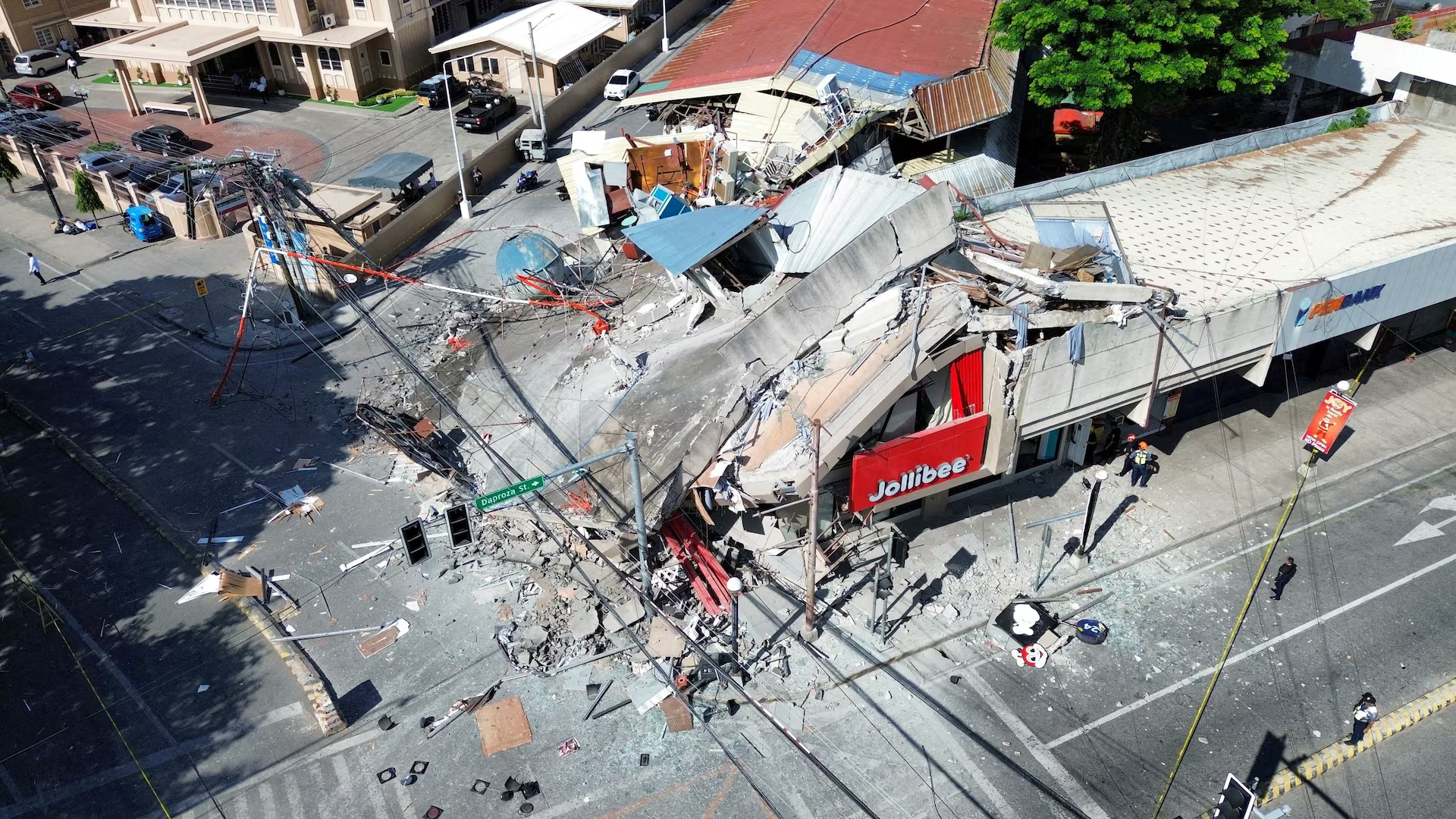
The National Disaster Risk Reduction and Management Council confirmed at least 46 deaths, 688 injuries, and 38 missing persons as of Friday night, with several buildings in Central Mindanao and the Davao Region either collapsing or being deemed structurally unfit, including the elementary school building of Notre Dame of Dadiangas University and a fast food outlet in General Santos City.
Bacolcol said the six active trenches in the Philippines operate independently of one another, directly addressing public concern that the June 8 event could set off a chain reaction across other fault systems.
“Hindi naman, kasi malalayo naman ‘yung mga trenches natin. Hindi naman sila kabit-kabit. So hindi po ‘yan makapag-activate ng ibang mga trenches natin,” Bacolcol said.
He said the Cotabato Trench earthquake is comparable in scale to the August 17, 1976 magnitude 8.1 Moro Gulf earthquake—which generated a tsunami 8 to 10 meters high and killed around 8,000 people—and noted that PHIVOLCS has activities prepared for this year’s 50th anniversary commemoration of that disaster in August.
On the question of whether a similar event could be predicted in the future, Bacolcol was direct: no technology currently exists to predict the exact timing of an earthquake, and the best the science can offer is an estimate based on historical recurrence patterns—leaving preparedness as the only reliable strategy.
As of 7:00 AM Saturday, 4,554 aftershocks have been recorded since the main shock, with the strongest at magnitude 6.4, and daily counts declining from 1,083 in the first 24 hours to 739 by June 12-13, following a decay pattern consistent with what seismologists expect after a major seismic event.
(Drone photo by Reuters)