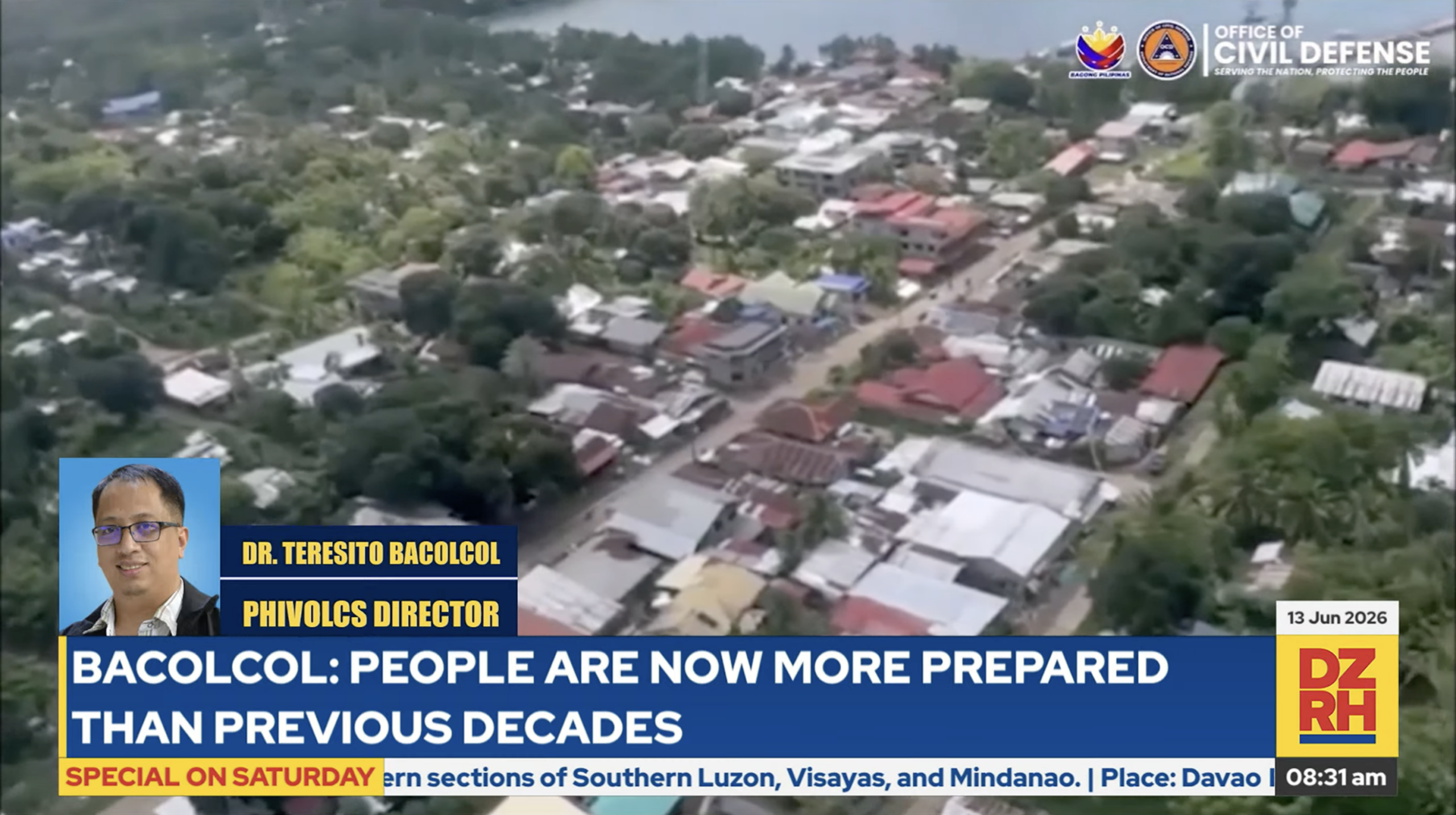
No technology currently exists that can predict the exact date, time, or location of an earthquake, the director of the Philippine Institute of Volcanology and Seismology (PHIVOLCS) said Saturday, stressing that preparedness—not prediction—remains the only reliable defense against seismic disasters.
PHIVOLCS Director Teresito Bacolcol made the statement in an interview on DZRH News program Special on Saturday on June 13, days after a magnitude 7.8 earthquake struck Southern and Central Mindanao on June 8, killing at least 46 people, injuring 688, and leaving 38 missing.
“Earthquakes are random events, and as of now, there is no technology yet that can tell us exactly when an earthquake would happen, the exact day, the exact time,” Bacolcol said.
He said science can only offer estimates based on paleoseismology—the study of prehistoric earthquakes—citing the West Valley Fault as an example, which is known to move every 400 to 600 years and last ruptured in 1658, placing its next possible movement anywhere between 2058 and 2258.
“If we consider the lower limit, which is 400 years, 1658 plus 400 years, that would be 2058. But we do not know exactly. It could be earlier or it could be later, or it could even be on its upper limit, which is 600 years,” Bacolcol said.
The June 8 earthquake originated from the Cotabato Trench, one of six active trenches in the Philippines—all capable of generating magnitude 8 and above earthquakes—with the strongest recorded intensity of 8 in General Santos City, Jose Abad Santos, and parts of Surigao del Norte, and shaking felt as far as Abuyog, Dulag, Javier, and Palo in Leyte, and Hinundayan, Libagon, Saint Bernard, San Francisco, and San Juan in Southern Leyte, and even reaching Carcar City in Cebu.
Bacolcol said 4,554 aftershocks have been recorded as of 7:00 AM Saturday, with daily counts declining from 1,083 in the first 24 hours to 739 by June 12-13, and projected to further taper to around 100 to 200 on the 10th day and 10 to 30 on the 100th day.
Former Senator Orly Mercado, who joined the interview as a studio guest, asked whether the Philippines could leapfrog its disaster preparedness gaps using artificial intelligence and technology, noting that countries like Japan have normalized earthquake risk and significantly reduced casualties through systematic preparation.
Bacolcol said awareness has improved significantly compared to two or three decades ago, with social media and the internet accelerating the spread of information during seismic events—a development he credited with making Filipinos more prepared than previous generations.
He said the best course of action remains preparedness at every level—from individual households practicing duck-cover-hold, to LGUs strictly enforcing the building code—emphasizing that the Philippines, as part of the Pacific Ring of Fire, must accept that earthquakes are a permanent feature of life in the archipelago.