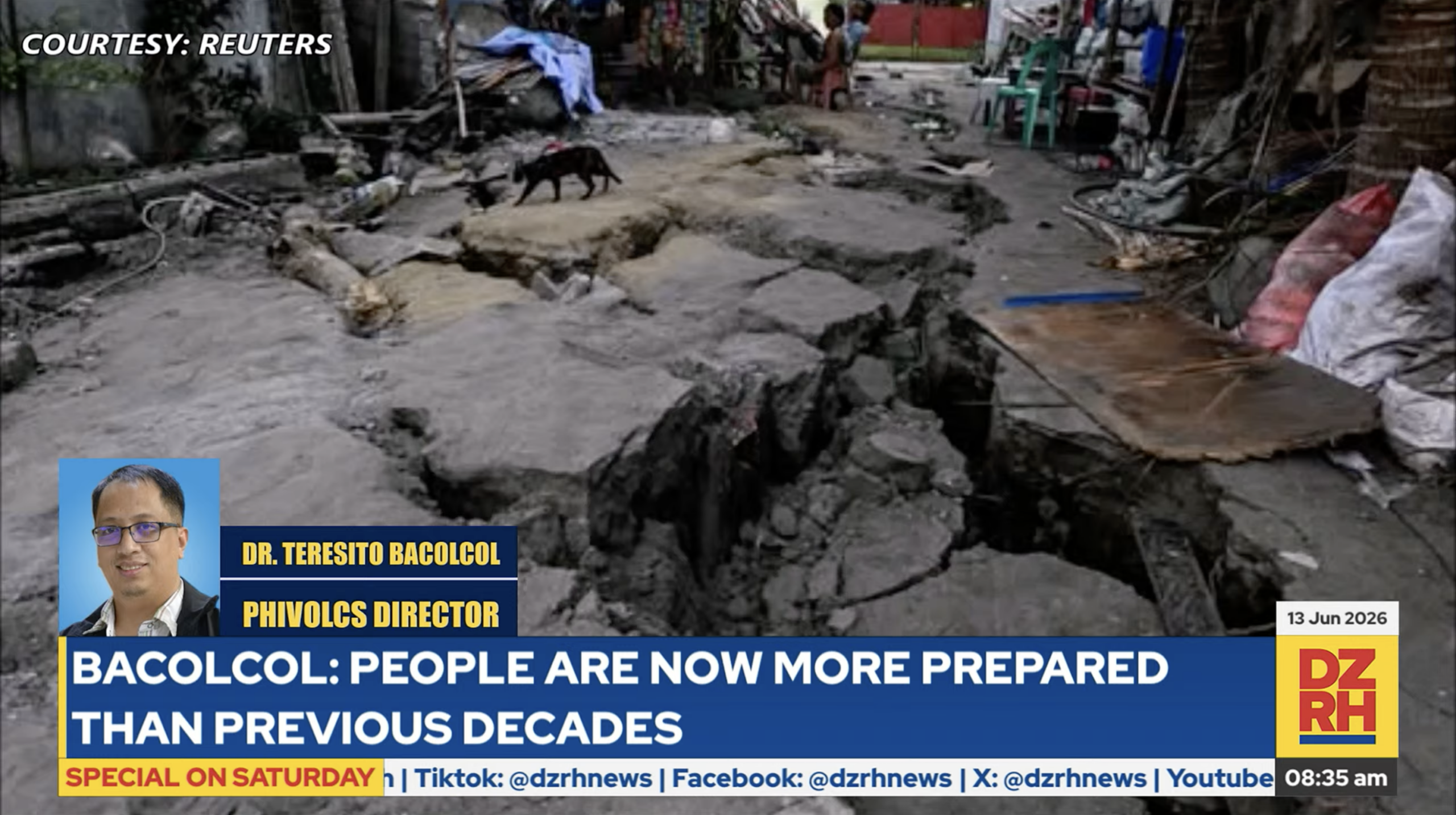
The number of aftershocks recorded following the magnitude 7.8 earthquake that struck Southern and Central Mindanao on June 8 has reached 4,554 as of 7:00 AM Saturday, with daily counts showing a gradual decline, the director of the Philippine Institute of Volcanology and Seismology (PHIVOLCS) said.
PHIVOLCS Director Teresito Bacolcol made the disclosure in an interview on DZRH News program Special on Saturday on June 13, saying the strongest aftershock so far measured magnitude 6.4 and occurred within hours of the main shock.
“Nasa 4,554 aftershocks na tayo. Ang pinakamataas, 6.4, nangyari ito noong June 8, hours after nagkaroon tayo ng main shock,” Bacolcol said.
He said the daily aftershock count has been on a downward trend—from 1,083 in the first 24 hours, to 966 the following day, and down to 739 in the 24 hours ending Saturday morning—a pattern consistent with what seismologists expect after a major seismic event.
Bacolcol said the decay rate of aftershocks follows a predictable pattern, projecting around 100 to 200 aftershocks on the 10th day after the main shock and around 10 to 30 on the 100th day, with both the frequency and magnitude of aftershocks expected to continue declining over time.
The June 8 earthquake, which originated from the Cotabato Trench, recorded a highest intensity of 8 in General Santos City, Jose Abad Santos, and parts of Surigao del Norte, with shaking felt as far as Abuyog, Dulag, Javier, and Palo in Leyte, and Hinundayan, Libagon, Saint Bernard, San Francisco, and San Juan in Southern Leyte, and even reaching Carcar City in Cebu, Bacolcol said.
The National Disaster Risk Reduction and Management Council revised the death toll down to 46 from an earlier count of 55 on Friday night, with 688 individuals injured and 38 still missing, citing continuous validation of reports as the reason for the change in figures.
Several buildings in Central Mindanao and the Davao Region either collapsed or were deemed structurally unfit following the quake, including the elementary school building of Notre Dame of Dadiangas University in General Santos City, as well as a fast food outlet and a supermarket in the same area.
Bacolcol said the Cotabato Trench is one of six active trenches in the Philippines—alongside the Philippine Trench, East Luzon Trough, Manila Trench, Negros Trench, and Sulu Trench—all of which are capable of generating magnitude 8 and above earthquakes.
He said aftershock activity is expected to continue but gradually taper off, and urged the public to remain alert and follow the guidance of local disaster risk reduction and management offices in affected areas.