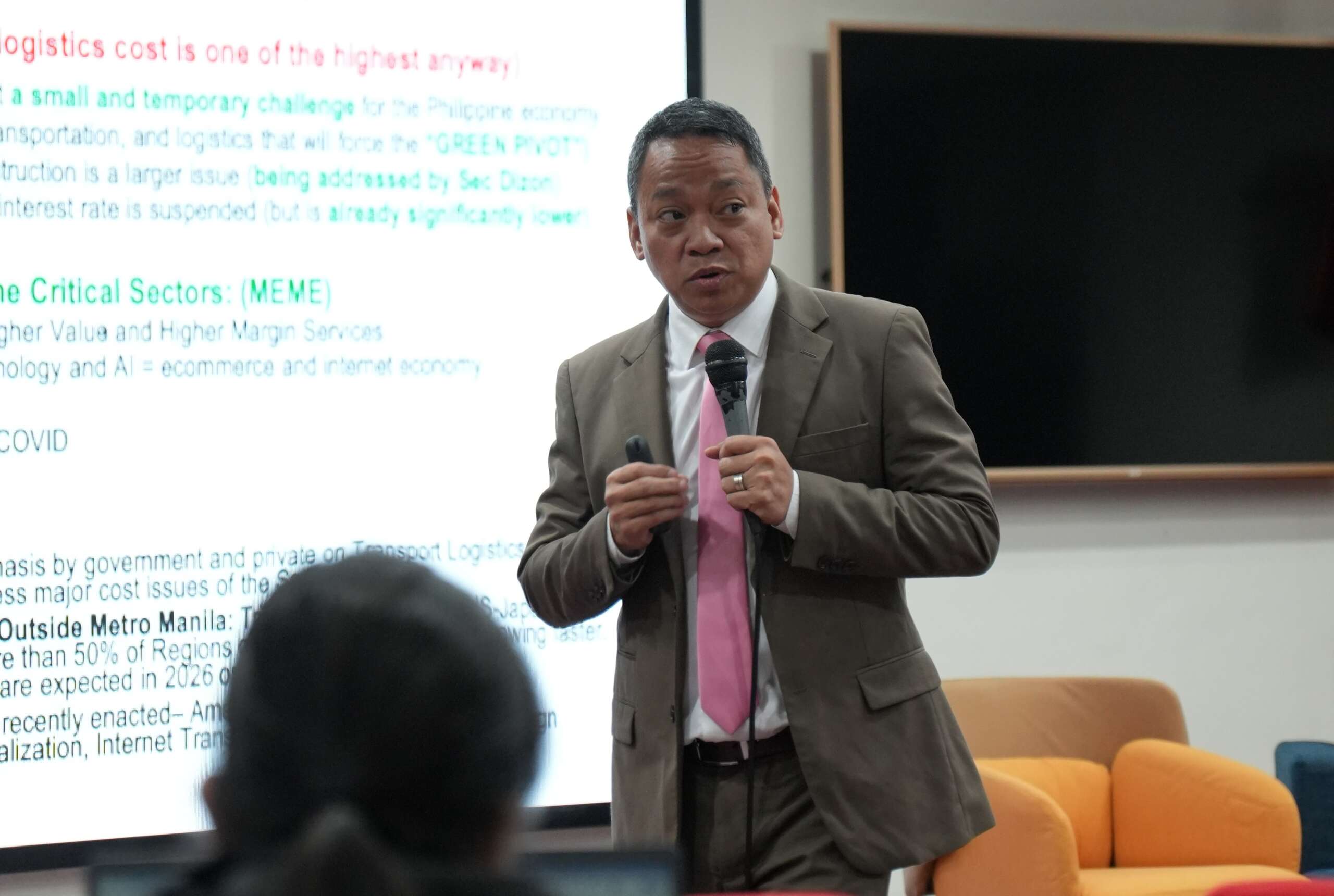
While the country’s attention has been consumed by rising fuel prices, an economist is arguing that the Philippines walked into the oil crisis already in the grip of a more damaging emergency—one that has been quietly dragging economic growth to some of its lowest levels in recent history, and that has received almost none of the public alarm it deserves.
University of Asia and the Pacific (UA&P) economist and Trade Supply Chain and Logistics consultant Ronilo Balbieran made the case during a forum on critical sectors held Wednesday, April 29, warning that the collapse in government infrastructure disbursements is inflicting damage on the economy that dwarfs what the oil shock has done so far.
“The delay and lack of disbursement for infrastructure projects have led our economy to an unimaginable 4.4% GDP growth in 2025,” he said. “For me, that is a larger crisis that we are not yet sure we have arrested.”
Balbieran laid out the spending numbers in stark terms. Government infrastructure disbursements fell by negative 8.2% in the middle of the midterm election period, then dropped by negative 26% following President Ferdinand Marcos Jr.’s “mahiya naman kayo” pronouncement against corrupt politicians.
It then fell further to negative 42%—a contraction he described as equivalent in proportion to pandemic-era spending collapses. “This negative government spending is the reason our GDP went down to one of the lowest in history at 3%, dragging our overall growth to 4.4%,” he said.
He was pointed in noting that the problem is not new, and that it cuts across administrations. Drawing a parallel to the Aquino administration’s “Tuwid na Daan” era, Balbieran noted that infrastructure spending fell by as much as negative 62% during that period—also resulting in 3% GDP growth.
“Whether it’s due to corruption or ‘clean’ procurement, if you don’t spend the taxes collected, infrastructure and economic growth suffer,” he said.
The economist argued that the infrastructure crisis is in some ways more insidious than the oil shock because it is self-inflicted and entirely within the government’s power to fix—yet it persists. Oil prices are driven by geopolitics and global supply dynamics beyond Manila’s control. Unspent infrastructure budgets are not.
“In a way, this is a crisis we badly needed to trigger reform,” Balbieran said, suggesting that the oil shock may have at least forced overdue conversations about transport and logistics that the infrastructure crisis alone had failed to spark.
He also flagged what he sees as the single most important reform the government has yet to adopt: full online procurement. As long as bidding, submission, evaluation, and awarding of infrastructure contracts remain offline or partially manual, he argued, the system will remain slow, opaque, and vulnerable to the same bottlenecks that have produced the current disbursement collapse.
“Until the government adopts full online bidding, submission, evaluation, and awarding, they are not serious about infrastructure reform,” he said.
Balbieran also pointed to a longer-horizon solution currently moving through the Senate. He cited the 30-year Comprehensive Infrastructure Development Master Plan (CIDMP) legislative measure filed by Senator Sherwin Gatchalian as the kind of durable, planning-horizon commitment the country needs to break the cycle of infrastructure spending that rises and falls with political cycles.
Without a program that outlasts individual administrations, he suggested, the country will keep repeating the same pattern of underspending followed by crisis.
The broader consequence, he argued, is that the Philippines is paying for its infrastructure deficit in ways that rarely make headlines but show up everywhere in daily economic life.
The country already carries the most expensive logistics cost in Asia at 27% of sales, compared to Thailand’s 11%. Roads that cannot move goods efficiently, ports that cannot turn around cargo quickly, and supply chains built around workarounds rather than reliable infrastructure all feed into that figure — and into the food and transport prices that Filipinos are now being told to blame on oil.
What struck Balbieran most, he said, was how quickly the oil crisis displaced the infrastructure conversation even as it was just beginning. The day after fuel prices showed signs of easing, he observed, traffic congestion returned to pre-crisis levels almost immediately—suggesting that the pressure for reform had already dissipated.
“Yesterday was an extraordinary return of traffic congestion,” he said. “I was going out of Tower 2 of Ayala, and it took me 45 minutes just to get out because Makati, BGC, and Pasay were all congested at 6:33 PM.” He did not hide his frustration. “Sana man lang medyo tumagal-tagal ng konti para talagang na-discuss namin ang mga reforms in transport and logistics,” he said in jest.
The oil crisis will ease, Balbieran said—he has been consistent in that view throughout the forum. But the infrastructure deficit will not resolve itself, and the window for reform that a crisis briefly opens tends to close faster than the crisis itself.
The question he left hanging was whether the country would use the current moment to fix something it has been putting off for decades, or whether it would simply wait for the next emergency to have the same conversation all over again.